
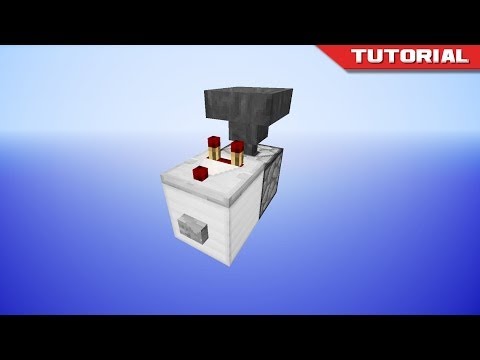
Video: HI-LO Tech: The Monostable Circuit by Mumbo Jumbo
How to build it
- Rising Edge (Piston): Place the Input & Piston
Place a solid input block with a button on it. Directly next to or in front of it, dig one block down and place a sticky piston facing upwards with a solid block on its face.
- Rising Edge (Piston): Add the Output Repeater
Run your input signal into the block sitting on top of the sticky piston, and place a redstone repeater facing away from the other side of that block. When triggered, the signal passes through the block for 1 tick before the piston pushes it up and cuts off the connection.
- Rising Edge (Silent Dropper-Hopper): Place Dropper & Hopper
For a silent, slightly longer pulse, place a dropper facing upwards. Sneak and place a hopper directly on top of the dropper, facing straight down into it.
- Rising Edge (Silent Dropper-Hopper): Add Item & Comparator
Put any single item inside the dropper. Place a redstone comparator facing away from the top hopper to read its inventory, and run your input signal directly into the dropper.
- Convert Any Design to a Falling Edge Circuit
To make either circuit fire at the end of a button press instead of the beginning, invert the input before it enters the circuit. Place a solid block with a button on one side and a redstone torch on the opposite side leading into your piston or dropper.
- Build the Dual Edge Monostable Circuit
To get a short pulse when the signal turns ON and another when it turns OFF, build a 1-wide line where the input splits to a sticky piston pushing a block to cut off a redstone wire, alongside a delayed repeater line. The piston's extension delay lets a pulse through at the start, and its instant retraction lets the lingering repeater power through at the end.
How it works
Monostable circuits rely on precise component delays to interrupt or briefly complete a redstone path:
- Rising Edge (Piston Circuit Breakers): When you press the button, power immediately travels through the solid block on top of the sticky piston and into the output repeater. At the same time, the sticky piston begins to extend. Because a piston takes 1.5 redstone ticks to move a block, the signal gets through for just 1 tick before the block rises and breaks the circuit.
- Rising Edge (Dropper-Hopper): Powering the dropper shoots its single item upwards into the hopper. The comparator detects the item and emits a pulse while the hopper immediately pushes the item back down into the dropper, resetting the system automatically.
- Falling Edge: By inverting the input with a
redstone-torch, the sticky piston stays extended (or the dropper stays powered) by default. Pressing the button turns the torch off, retracting the block back into position. No signal passes until the button pops back out and the torch turns back on, triggering the 1-tick pulse at the very end of the input. - Dual Edge: When the input turns on, signal races through a wire before a sticky piston extends a block to cut the wire off (first pulse). When the input turns off, the sticky piston retracts its block instantly, re-opening the wire just in time for the delayed signal from a repeater to slip through before dying out (second pulse).
Tips & variations
- T Flip-Flop Trick (Java Edition): The 1-tick pulse from the rising-edge piston monostable circuit is brief enough to make another sticky piston 'spit out' its block on Java Edition, converting any button into a toggle switch.
- When to Use Falling Edge: Falling edge circuits are vital for double piston extenders, where the middle piston needs an extra pulse during the retraction phase after the main power turns off.
- Silent Operation: If piston noise bothers you in your base, use the dropper-hopper variant. Note that its comparator output gives a slightly longer pulse than 1 tick, and you may want a repeater after the comparator to boost the signal strength to 15.
- Java vs. Bedrock Note: The dropper-hopper monostable circuit works reliably across versions, whereas 1-tick piston block-spitting and instant piston retraction timings are specific to Java Edition.


