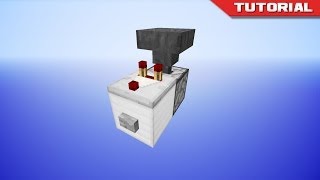
Video: Monostable Circuit (One-Shot) in Redstone | Java Minecraft 1.21 by VidMC
How to build it
- Dig a 1-Block Hole
Choose the spot along your redstone line where you want the pulse limiter to sit and dig out a single block in the ground.
- Place the Upward Piston
Place a regular Piston (not a sticky piston) inside the hole facing straight up.
- Top with Sand
Place a block of Sand (or Gravel) directly on top of the upward-facing piston face so it sits flush with the ground.
- Add the Input Repeater
Place a Redstone Repeater on the ground pointing directly into one side of the sand block, leaving it on its default 1-tick delay.
- Add the Output Repeater
On the opposite side of the sand block, place a second Redstone Repeater facing away from the sand to carry the shortened pulse out.
- Connect Input and Output
Wire your button or lever into the back of the input repeater, and connect the front of the output repeater to your sticky piston or machine.
How it works
This circuit relies on the brief delay between a repeater powering a block and a piston moving that block out of the way:
- Rising Edge Trigger: When you press the button or flip the lever on, the input
Redstone Repeaterstrongly powers theSandblock. - Signal Transfer: The output
Redstone Repeaterimmediately pulls power from the sand block and sends a pulse down your output line. - Circuit Breaker: At the exact same moment the sand is powered, it activates the regular
Pistonunderneath it. The piston extends and pushes the sand upward, replacing the solid block with a piston head that cannot conduct redstone power. - 1-Tick Cutoff: Because the sand moves out of the path after just 1 redstone tick, the output signal is instantly cut off, even if the input remains powered.
- Reset Phase: When the input turns off, the piston retracts and gravity drops the sand back into place after the input repeater is already off, preventing a second pulse.
Tips & variations
- Java Edition Feature: A 1-tick pulse causes Sticky Pistons in Java Edition to push a block out and leave it behind, then retract it on the next pulse—creating a super simple T Flip-Flop. Note that Bedrock Edition sticky pistons do not spit out their blocks on a 1-tick pulse.
- Block Substitution: You can use Gravel, Concrete Powder, or any other gravity-affected solid block in place of Sand.
- Common Mistake: Make sure the upward-facing piston is a regular Piston. If you use a Sticky Piston in the ground, there is no difference in function, but a regular piston saves you a Slimeball in survival!
- Why Not an Observer? Watching a button line directly with an Observer outputs two pulses (one when the button turns on, and another when it pops back out). This circuit only fires once per button press.