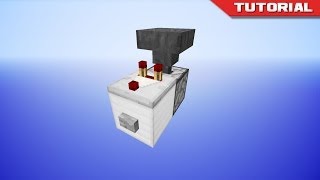
Video: Mono-Stable Circuits And Piston Spitters | Learning Minecraft Bedrock Edition Redstone Series Ep 4 by ScottyO
How to build it
- Rising Edge: Place Input and Dust
Place one solid block on the ground with a button or lever attached to the front face, and put a piece of redstone dust on top of that block.
- Rising Edge: Add the Sticky Piston
Behind the first block, place a sticky piston facing upward so that it is adjacent to the redstone dust, then place a solid block on top of the sticky piston's head.
- Rising Edge: Add the Output Repeater
Place a third solid block behind the sticky piston, put a redstone repeater on top of it facing away from the piston block, and connect it to your redstone lamp or circuit.
- Falling Edge: Swap the Block for an Observer
To make a falling-edge monostable circuit instead, build the same base with a solid block, input, redstone dust on top, and an upward-facing sticky piston right behind it.
- Falling Edge: Orient the Observer and Output
Place an observer on top of the upward sticky piston so its red output dot faces toward the back, followed by a solid block and a repeater leading into your output device.
- Bedrock Block Spitter: Place the Double Pistons
Since Bedrock sticky pistons do not spit blocks with a normal monostable circuit, place two sticky pistons in a line facing the same direction, with a solid block in front of the lead piston.
- Bedrock Block Spitter: Attach the Mover Piston and Observer
Place an observer beside the back sticky piston so its output points into the pistons, then place a third sticky piston with a lever on it arranged to push and pull that observer back and forth between the two pistons.
- Vertical Block Spitter Variant
You can also build the block spitter vertically by stacking two upward-facing sticky pistons with a block on top, an observer facing into the side of the stack, and an upward sticky piston powered by a lever underneath the observer.
How it works
Each circuit shapes pulses or controls piston movement differently in Bedrock Edition:
- Rising-Edge Monostable: When you press the button or flick the lever ON, the redstone dust powers both the solid block sitting on the sticky piston and the sticky piston itself. The repeater briefly receives power through the block right before the sticky piston pushes the block upward and cuts the connection, creating a super quick pulse.
- Falling-Edge Monostable: When the input turns ON, the sticky piston pushes the observer up out of alignment. When the signal turns OFF (the falling edge), the sticky piston retracts the observer back down in front of the output block, firing a single quick pulse through the repeater.
- Bedrock Block Spitter: Shifting the observer with a third sticky piston fires the two aligned sticky pistons in sequence. Moving it one way pushes the second piston and block forward so the block extends out; moving it back activates the front piston to grab and retract the block.
Tips & variations
- Java vs. Bedrock Difference: In Java Edition, feeding a 1-tick pulse from a monostable circuit into a sticky piston makes it spit out its block. In Bedrock Edition, sticky pistons never drop their blocks from short pulses, so you must use the 3-piston observer shifter shown here to get a block-spitting motion.
- Levers vs. Buttons: Monostable circuits are especially useful with levers because a lever normally stays on continuously, which would jam sequential circuits like double piston extenders.
- Keep It Compact: Avoid bulky redstone torch falling-edge designs when the simple upward piston with an observer achieves the same result with far fewer materials.