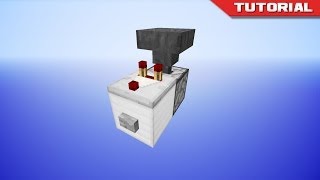
Video: 10 Redstone Circuits You Should Know by TheLumbleHumberJack
How to build it
- 1. Circuit-Breaker Pulse Generator
Route an input button into a repeater leading through an opaque block resting on top of an upward-facing sticky piston, while also branching the input to power that piston. When triggered, the signal passes through the block for 1 tick before the piston pushes the block up and cuts the connection.
- 2. Zero-Delay Piston Cut-Off
Run a line of redstone dust through a trench or corner straight to your output with no repeaters, and place a sticky piston holding an opaque block right next to the wire. Pressing the button powers both the wire and the piston simultaneously, letting a 1-tick zero-delay pulse through before the block is pushed over the dust to sever the line.
- 3. Off-Pulse Generator
Keep your output line continuously powered by two redstone torches arranged so that one torch is normally on and the other is held off by your input block. When you press the input button, the active torch turns off 1 tick before the second torch turns on, creating a brief 1-tick unpowered pulse (making an extended piston quickly retract and re-extend).
- 4. Pulse Length Limiter
Direct a repeater into the side of a movable opaque block held by a sticky piston, and place your output on the opposite side of that block. Branch the input signal through another repeater directly into the sticky piston so that as soon as power arrives, the block is pushed out of the repeater's path after a single tick.
- 5. Repeater Line Pulse Extender
Run a straight line of redstone dust from your button to the output, then build a parallel line of 4-tick repeaters connected to opaque blocks alongside the dust. The initial signal travels down the dust immediately with zero delay, while each delayed repeater re-powers the main line in sequence to keep the output active longer.
- 6. Hopper Clock Pulse Extender
Build a standard Etho hopper clock with two hoppers facing each other, comparators reading them into blocks, and a redstone block between two pistons, but use one sticky piston and one regular piston. Triggering the regular piston pushes the redstone block to start the timer; items then transfer until the sticky piston pulls the block back and resets the circuit.
- 7. Dual-Edge Dispenser Pulse Multiplier
Split the redstone line from a single stone button into two separate branches leading into opposite sides of a dispenser, adding repeater delay to one of the branches. Pressing the button once fires the dispenser immediately via the fast branch and a second time via the delayed branch, letting you quickly dispense and retract water or lava.
- 8. Toggled Clock Pulse Multiplier
Connect a basic redstone clock to a note block or output device, and hold the clock locked until an input signal enables it. While the stone button is active, the clock cycles repeatedly to generate multiple output pulses before shutting off when the button pops out.
- 9. Binary Piston Pulse Divider
Set up a chain of sticky pistons moving opaque blocks to alternate the signal path in a binary counting arrangement. Each time you press the input button, the blocks shift configuration so that an output pulse only passes all the way through to the lamp on every fourth press.
- 10. The Observer (1-Block Monostable)
Place a single observer with its face pointing toward any block or component that changes state. Its output back stays permanently unpowered until it detects a block update in front of it, emitting a short pulse and immediately returning to its stable off state.
How it works
Every circuit in this collection follows the core definition of a monostable circuit: it has only one stable state. No matter how long or short the input trigger is, the circuit temporarily shifts to its unstable state and then returns home.
- Pulse Generators & Limiters (Circuits 1–4): These rely on race conditions between redstone lines and pistons or torches. Power passes through an opaque block or wire for just 1 redstone tick before a sticky piston physically moves a block to break the circuit (or a secondary torch kicks in to restore power in the off-pulse variant).
- Pulse Extenders (Circuits 5–6): Instead of cutting a signal short, these hold the unstable state longer. The repeater chain feeds delayed power back into the main wire piece by piece, while the modified hopper clock uses item transfer time between two hoppers to dictate how long the redstone block stays in its triggered position.
- Pulse Multipliers & Dividers (Circuits 7–9): Multipliers split one pulse into two delayed paths or temporarily unlock a fast clock to fire an output several times from one press. Dividers use pistons to toggle block positions like a binary counter, blocking three out of every four pulses.
- Observer (Circuit 10): Acts as a built-in, single-block monostable generator by converting any block state change into a brief redstone pulse.
Tips & variations
- Adjusting Pulse Length: On the circuit-breaker pulse generator (Circuit 1), increasing the tick delay on the repeater entering the movable block will increase both the initial delay and the duration of the output pulse.
- Customizing the Hopper Extender: Add or remove stackable items inside the hoppers of Circuit 6 to fine-tune exactly how long the output stays powered.
- Scaling the Divider: The binary piston pulse divider (Circuit 9) is tileable outwards—adding more stages increases the number of button presses required before an output pulse escapes.
- Java vs. Bedrock Note: Most repeater, torch, observer, and hopper extender layouts work in both editions, while fast 1-tick sticky piston block-dropping behaviors (such as in the binary divider or 1-tick piston cut-offs) rely on Java Edition piston mechanics.