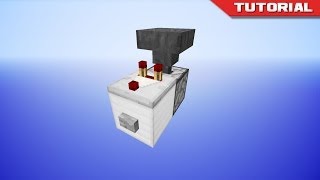
Video: 6 Easy Monostable Circuits for Bedrock Edition by Darth_ Dub_
How to build it
- Leading-Edge 1: Piston Block-Breaker
Place an input block with a lever, followed by a solid conductive block with redstone dust on top. Next to that block, dig down one block and place a sticky piston facing up with another conductive block on its face. Run a redstone repeater out from the piston's block into your output lamp.
- Leading-Edge 2: Adjustable Torch & Repeater
Place an input block with a lever and attach a redstone torch to its side (using a Jack o'Lantern reduces lighting lag). Run a repeater set to 2, 3, or 4 ticks out of the input block into a solid block with redstone dust on top, making sure the first torch also powers this dust. Place a block next to the dust with an output redstone torch attached to it.
- Leading-Edge 3: Dropper-Hopper Pulse
Place an input block with a lever next to a dropper. Attach a hopper feeding directly back into that dropper and put a single random item inside the dropper. Place a redstone comparator reading from the hopper to serve as your output.
- Falling-Edge 1: Locked Hopper Loop (Part 1)
Place an input block with a lever and run a repeater out of it directly into an upward-facing dropper to hard-power it. Place a hopper on top of the dropper, a second hopper next to it pointing down, and a third hopper below that pointing back into the dropper to create a 2x2 loop.
- Falling-Edge 1: Locked Hopper Loop (Part 2)
Drop a single item into the dropper. Place a redstone comparator reading out from the bottom hopper (the one feeding back into the dropper) to act as your falling-edge output.
- Falling-Edge 2: Repeater Lock Circuit
Place an input block with redstone dust in front of it, branching into two paths. On the main output path, place a 2-tick repeater running into another repeater (which will be locked), leading to your output. On the side path, place a 1-tick repeater running directly into the side of the second repeater on the main path to lock it.
- Falling-Edge 3: 1-Wide Dual Torch
Place an input block (like a Jack o'Lantern) with a redstone torch on the front and a piece of redstone dust on top if powering from the side. In front of the block, place a repeater (set to 2, 3, or 4 ticks) running into a second block that also connects to the first torch. Attach a second redstone torch to this final block as your output.
How it works
Monostable circuits isolate either the activation (leading/rising edge) or deactivation (falling edge) of a redstone signal:
- Leading-Edge 1 (Piston): The dust powers the block above the piston before the piston extends. The repeater grabs a brief pulse before the piston pushes the conductive block upward and breaks the connection. Note: In Bedrock, you must use redstone dust before the piston block rather than a repeater.
- Leading-Edge 2 (Torch): The output torch is normally kept off by the first torch. When you flip the lever, the first torch turns off immediately while the repeater delays the new ON signal, allowing the output torch to flash on for 2 to 4 ticks.
- Leading-Edge 3 (Dropper-Hopper): Powering the dropper shoots the item into the hopper. The comparator detects the item and pulses briefly before the hopper pushes the item back into the dropper.
- Falling-Edge 1 (Hopper Loop): The repeater hard-powers the dropper, shooting the item into the top hopper while simultaneously locking that hopper. Only when you turn the lever OFF does the top hopper unlock, allowing the item to cycle through the bottom hopper and trigger the comparator.
- Falling-Edge 2 (Repeater Lock): The 1-tick side repeater locks the output repeater before the 2-tick signal arrives. When power is turned off, the 1-tick side unlocks first while the 2-tick repeater still holds a momentary charge, letting a brief pulse escape.
- Falling-Edge 3 (Dual Torch): While unpowered, the first torch keeps the output torch off. Turning the input ON turns off the first torch, but the repeater keeps the line powered once it catches up. When you turn the input OFF, the repeater holds the line off briefly while the first torch takes a moment to turn back on, creating a pulse on the falling edge.
Tips & variations
- Lag Reduction: Placing redstone torches on light-emitting blocks like Jack o'Lanterns prevents constant lighting updates when the torch flashes, reducing frame drops and lag.
- Adjusting Pulse Length: On the torch-and-repeater designs, changing the repeater delay between 2, 3, and 4 ticks directly controls how long the output pulse stays active. Do not set it to 1 tick on Leading-Edge 2, as the torch and repeater will fire simultaneously and produce no pulse.
- Bedrock Specifics: In the Piston Block-Breaker (Leading-Edge 1), you must use redstone dust on top of a conductive block to power the block above the piston. Using a repeater into the block will fail to transfer power properly in Bedrock Edition.
- Side Inputs on 1-Wide Circuits: If you power the 1-Wide Falling-Edge circuit from the side, place a piece of redstone dust on top of the first input block so both the torch and the lower repeater receive the signal.