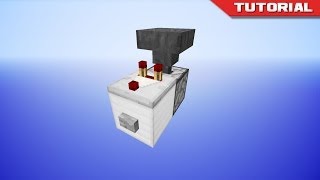
Video: T-Flip Flops And Monostable Circuits: EXPLAINED! by Mumbo Jumbo
How to build it
- Set Up a Rising Edge Monostable
Place a lever as your input leading into a rising edge monostable circuit. When you flick the lever on, the circuit immediately cuts off its own path after a split second, sending out one short pulse at the very start of the input.
- Build a Falling Edge Monostable
Wire a second lever into a falling edge monostable layout. Unlike the rising edge version, turning this lever on does nothing to the output; instead, the single short pulse is emitted only when you flick the lever back off.
- Combine into a Dual Edge Monostable
Merge the rising edge and falling edge concepts into a dual edge monostable circuit. Connect a lever to the input and test it: you will get a short output pulse when you switch the lever on, and a second pulse when you switch it off.
- Build a Sticky Piston T Flip-Flop
Connect a button to a fast 1-tick rising edge monostable circuit, and feed that 1-tick output into a sticky piston holding a block (such as a redstone block or a solid block over a power source). Pressing the button once spits the block out into the 'on' position; pressing it again retracts the block to toggle the output off.
- Build the Dropper T Flip-Flop Variant
For a pistonless alternative, arrange droppers and hoppers in a closed loop with a single item inside. Place a comparator reading one of the containers so that each input pulse shifts the item, toggling the constant comparator output on and off.
How it works
These two circuit families manipulate pulse length in opposite ways:
- Monostable Circuits: Designed to emit a single brief pulse regardless of how long the input stays powered. A rising edge monostable triggers at the very beginning of a redstone signal (ON transition). A falling edge monostable waits until the signal turns off (OFF transition) before firing its pulse. A dual edge monostable combines both behaviors, pulsing once on activation and once on deactivation.
- T Flip-Flops (Toggle Flip-Flops): Do the exact reverse by turning a momentary pulse into a persistent redstone output—effectively making a button act like a lever.
- 1-Tick Piston Mechanic: In Java Edition, when a sticky piston receives a 1-tick pulse from a fast monostable circuit, it pushes its block forward and retracts its arm immediately without pulling the block back. A second 1-tick pulse causes the sticky piston to grab and retract the block again, creating a reliable toggle state.
- Dropper Loop Mechanic: Instead of relying on piston block-spitting, the dropper T flip-flop cycles a single item through containers each time a pulse arrives, allowing a comparator to read the item's presence as a toggled constant signal.
Tips & variations
- When to use a T Flip-Flop instead of a Lever: While a lever gives a constant signal manually, many redstone inputs only produce short pulses—such as buttons, pressure plates, detector rails, or items passing through hoppers. A T flip-flop lets any of those momentary triggers toggle a system on or off permanently.
- Double Piston Extenders: Rising, falling, and dual edge monostables are heavily used to time the extension and retraction sequences in double piston extenders.
- Java vs. Bedrock Note: The sticky piston T flip-flop relies on sticky pistons spitting out their block on a 1-tick pulse, which is a Java Edition exclusive mechanic. If you play on Bedrock Edition, use the dropper-hopper item loop T flip-flop instead.