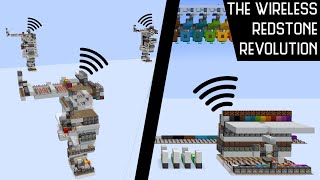
Video: New High Speed '5G' Wireless Redstone in Minecraft + Explanation by QQ
How to build it
- Orient the Build Direction
Before placing blocks, make sure your receiver's repeater lines face North or West. This directional alignment is required so the powered rails orient properly without using commands.
- Build the Receiver Item Dropper Slices
Create an 8-slice array (plus 1 reference slice on the end without an output) where each slice has a dropper facing onto a trapdoor above a hopper. Fill each dropper with stackable items so it can cycle items continuously into the hopper below.
- Install the Timing Comparators and Torches
Place a comparator reading each hopper beneath the trapdoors, running into a block with a redstone torch. Behind this, add a secondary dropper-hopper loop read by another comparator to power a 7-game-tick rail line.
- Set Up the BUD-Powered Output Droppers
Above the powered rails in each data slice, place an upward-facing dropper feeding into a hopper and comparator output line. Wire a 4-game-tick redstone clock (2 ticks on, 2 ticks off) synced to the reference slice to quasi-power the blocks above these droppers via observers and rails.
- Configure Tile-Tick Priority Repeaters
Run three rows of repeaters feeding into the receiver droppers. Set the leftmost repeaters closest to the droppers to higher delays than the right ones so the game schedules their tile-tick updates strictly from left to right within the exact same game tick.
- Build the 8-Slice Transmitter Array
At your remote transmitting location, build a matching 8-slice dropper array capable of firing 0 to 3 items per slice in a single game tick. Add staggered repeater lines behind the slices to enforce the same left-to-right tile-tick execution order.
- Match the Channel Delay Repeaters
Behind the priority repeaters on both the transmitter and receiver, set your channel repeaters to identical tick delays. Both machines must have matching total delays to operate on the same timing window.
- Synchronize with Daylight Detectors
Place a daylight detector on both the transmitter and receiver clock circuits. Break and replace the synchronization block on the transmitter first, then the receiver, during daylight changes; once all receiver comparators flash steadily, break the sync block so time-of-day updates do not re-trigger it.
- Encode Data and Transmit
Place blocks in the transmitter's input matrix to select which lines fire and press the transmit note block. Keep both areas loaded with chunk loaders to maintain synchronization permanently.
How it works
This transceiver sends data across any distance by manipulating and reading Minecraft's global Entity ID counter on a server:
- Lazy Item Grouping: Every newly spawned entity receives a sequential global ID. Stationary items on the ground only check for movement once every 4 game ticks, determined by
Entity_ID modulo 4(dividing items into groups 0, 1, 2, and 3). - Trapdoor Pickup Delay: When the receiver opens a trapdoor under a resting item, an item in group 0 enters the hopper below immediately (0 ticks), while groups 1, 2, and 3 float for 1, 2, or 3 game ticks before being picked up.
- Same-Tick Sandwiching: To prevent natural mob spawns from ruining the count, the receiver drops two items in adjacent slices within the exact same game tick using repeater tile-tick priority. Because tile ticks execute sequentially without mob spawning in between, the second item normally has an ID exactly 1 higher than the first.
- 2-Bit Modulation: If the remote transmitter drops 1, 2, or 3 items at the exact priority slot between the receiver's two items, the second receiver item's ID shifts by that exact amount.
- BUD Clock Decoding: The first slice acts as a reference, syncing a 4-gt clock (2 ticks on, 2 ticks off) that quasi-powers (BUDs) the output droppers of the adjacent slice. When a slice's hopper picks up its item, it powers a rail under its output dropper for 7 game ticks. Turning the rail on and off creates two block updates 7 ticks apart, sampling the 4-gt BUD line twice to decode 2 bits of data per slice per cycle.
Tips & variations
- Multiplayer Server Required: This circuit only works on a server (or a local server jar hosted on your PC). In singleplayer worlds, the client increments entity IDs for client-side effects, causing constant false signals.
- Directional Rails: Always build the receiver repeater lines facing North or West so the powered rails align properly.
- Scaling Up: Each slice provides 2 bits per second (8 data slices = 16 bits/s). To add more slices, extend the rail lines using instant repeater lines (observers and redstone blocks placed in even pairs).
- Troubleshooting Hoppers: All bottom comparators on the receiver should flash rhythmically. If a comparator stays solid, clear stuck items from its hopper; if it stays dark, refill its dropper.
- Do Not Stop the Receiver: Abruptly halting the receiver clock can cause items on the trapdoors to fall out of cycle. Synchronize once, remove the daylight detector link block, and leave it chunk-loaded.