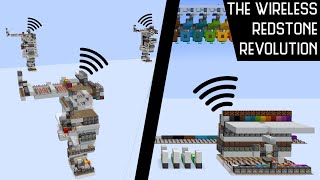
Video: Wireless Redstone in Minecraft 1.16+ Survival (Reliable + Unlimited Range) by 2No2Name
How to build it
- Build the Dropper & Trapdoor Core
Place the main testing droppers facing inward with four wooden trapdoors arranged in two pairs (two bottom, two top) between them and open the trapdoors. Enclose the front with glass blocks and place a Block of Redstone on each outer side.
- Install the Hopper Collection & Output
Place hoppers underneath the drop chamber to catch the dropped items, and take a comparator output from the hoppers. Have observers watch those comparators and feed into a repeater, comparator, and a 3-tick repeater to form the receiver output line.
- Wire the Note Block Dropper Triggers
Add glass, redstone dust, and note blocks above the sides, with observers reading the note blocks to power the droppers via quasi-connectivity. Close off the top with blocks and add note blocks to update the droppers and start the channel repeater chain.
- Build the 4-Chamber Dropper Reset Line
Route the signal upward to a row of four droppers paired with hoppers. Use a 3-tick repeater, a redstone torch, and redstone dust across the top, then enclose the chambers and place a few stackable items inside each, alternating between two different item types in adjacent cells so they cannot merge.
- Add the Signal Descent and Daylight Sensor
Step the signal down from the upper line using redstone dust, a redstone torch, and two 2-tick repeaters leading into lower redstone dust. Place a daylight detector toggled to night (inverted) mode with an observer reading it upward.
- Construct the 20gt Synchronized Clock
Place a regular piston with a lever above the daylight detector so pushing a block over the detector activates the circuit. Build the 1-second (20gt) clock loop using a 3-tick repeater, a comparator on a block above a redstone lamp, a 4-tick repeater, and a redstone torch, blocking the adjacent dust so it pulses every second.
- Connect the 6-Repeater Channel Line
From the clock output torch, run dust into a 2-tick repeater and comparator on one side and a 3-tick repeater on the other to join the 6-repeater channel chain. Set the six repeaters to a custom delay pattern (from 4,096 combinations) and load 18 unstackable items into the bottom dropper of the back item elevator.
- Build a Portable or Continuous Transmitter
Anywhere in the same dimension, place a dropper with items inside and run a chain of 6 repeaters matching your receiver's exact channel pattern into it, preceded by an initial 3-tick repeater. Trigger it during the day by placing a daylight detector at the start of the line, at night by placing a block over a daylight detector read by an observer and a 2-tick repeater, or continuously by attaching an identical daylight-synced 20gt clock.
How it works
This wireless system exploits how Minecraft assigns sequential Entity IDs to newly spawned entities combined with item-merging order:
- Daylight Detector Sync: Daylight detectors update at the exact same game tick across the entire dimension when internal sky light changes or when covered by a block, allowing the receiver's 20-game-tick (1-second) clock and the transmitter to fire in phase.
- Channel Timing: The chain of 6 repeaters delays the pulse to a specific game tick within the 1-second cycle. With 4 settings on 6 repeaters, there are
4^6 = 4096possible tick timings (channels). - Entity-ID Detection: On its scheduled tick, the receiver fires its droppers and checks the order in which dropped items interact/collect into the hoppers. If a remote transmitter dropper drops an item during the exact micro-window set by the channel repeaters, the global entity ID counter increments by one in between the receiver's actions, altering the hopper comparator output and firing the receiver's output lamp.
Tips & variations
- Multiplayer Server Only: As noted by 2No2Name, this design is meant for servers. In singleplayer, opening pause menus or local tick behavior can interfere with reliability.
- Chunk Loading: Build a nether portal chunk loader next to the receiver so it stays loaded while you travel thousands of blocks away.
- Avoid Channel Collisions: On shared SMP servers, pick a random 6-repeater delay configuration so another player's wireless network does not trigger your receiver.
- Adjacent Item Types: Always alternate two different stackable item types in the top dropper chambers so items from neighboring cells never stack together.
- More Channels: You can extend the repeater chain beyond 6 repeaters if you need even more channels.