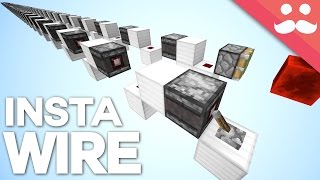
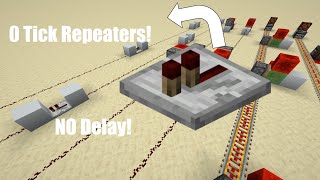
Video: Dissecting Minecraft #13: Instant Wire | Minecraft 1.13 by LogicalGeekBoy
How to build it
- Basic Retraction Instant Wire
Place a line of extended sticky pistons, each holding a redstone block that powers the next piston in the chain. When you cut power to the first piston, it starts retracting immediately, turning its redstone block into a moving block and instantly depowering every piston down the line in the same tick.
- Speed Up Reset with Dust & Torches
To reduce piston count and reset delay, run lines of redstone dust between your sticky pistons instead of placing pistons back-to-back. Add a redstone torch above the piston to quasi-power it so the torch relights quickly after triggering and resets the line much faster.
- Dual-Edge Zero-Tick Wire
Build a zero-tick pulse generator at each module by powering a bottom block while a top sticky piston moves a redstone block over the lower piston. This updates the quasi-connected piston to retract immediately, making both the rising edge and falling edge of your signal completely instant.
- Lag-Friendly BUD Powered Rail Line
Replace long redstone dust lines with powered rails to avoid lighting and dust power-drop lag. Keep the rail segments BUD-powered (tricked into staying active from a single power source), and place a piston-and-redstone-block update detector at the joint so turning off one rail instantly cascades across the whole line.
- Two-Way Rail & Redstone Redirect Wire
Space modules 17 blocks apart with powered rails in between. At each module, use a sticky piston moving a detector rail to redirect a piece of redstone dust away from a repeater and torch; because dust redirection does not cause a block update until triggered, this line transmits instant signals in both directions.
- Observer & Powered Rail Instant Wire
Lay a continuous line of powered rails powered from a static source at the end. Every 9th block (leaving 7 blocks between modules), place an observer watching the rail to repower the next rail segment; causing a block update at the start turns off the entire rail line on the exact same tick.
- Vertical Slime Block & Observer Wire
Stack sticky pistons, slime blocks, and redstone blocks vertically so retracting the bottom piston instantly pulls power down the column. Attach an observer and trapdoor to each slime block segment so the pistons reset simultaneously rather than waiting for a slow bottom-to-top chain reaction.
- Vertical 1.13 Bubble Column Instant Wire
Build a vertical column of water source blocks over a block of soul sand. Place a dispenser with an empty bucket facing the second water block above the soul sand (not directly on the soul sand); pulsing the dispenser twice removes and replaces the water source, causing the entire bubble column to update observers at any height in the exact same tick.
- Downward Hopper Chain & Daylight Sensor Options
For an instant downward signal, stack a vertical chain of hoppers pointing straight down; when the top hopper collects an item, every hopper below pulls it downward in the same game tick. Alternatively, cover or uncover a vertical shaft above a daylight detector to send a signal up to 255 blocks down.
How it works
Instant wire relies on mechanics that start or propagate within 0 game ticks rather than waiting for standard redstone components:
- Piston Retraction & Moving Blocks: While a piston takes 2 game ticks to finish extending, it starts moving immediately (0 ticks) when powered or depowered. The moment a sticky piston begins pulling a
Block of Redstone, that block converts into a moving block entity (Block 36) and stops emitting power on the very same tick. - Rail Update Cascading: Powered rails only check adjacent rails for power updates rather than recalculating their 9-block distance from a power source every tick. By keeping a rail line artificially powered (BUD-powered) and introducing a single block update, the entire rail segment turns off simultaneously in one tick.
- Bubble Column Propagation (1.13+): Removing the water source one block above soul sand destroys the bubble column state all the way to the top of the water shaft on the exact same tick, allowing observers along the pillar to fire simultaneously regardless of height.
- Vertical Hopper Pulling: Because hoppers actively pull items from the inventory above them within the same tick order, an item entering the top hopper of a vertical column is immediately sucked all the way to the bottom hopper in a single tick.
Tips & variations
- Avoid Redstone Dust for Long Lines: When redstone dust turns off, its signal strength drops step-by-step from 15 down to 0, causing massive block update lag over long distances. Always use powered rail or bubble column instant wires for long-distance transmission.
- Bubble Column Dispenser Placement: Make sure your dispenser buckets the water block one block above the soul sand. Bucketing the water directly on top of the soul sand updates instantly on removal, but takes 1 full second to reform when dispensed back.
- Two-Way Rail Spacing: When building the bidirectional detector-rail redirect wire, space the modules 17 blocks apart (one block less than the usual 18-block double rail limit) so the end rail has room to update the neighboring segment.
- Java Edition Mechanics: These circuits rely on Java Edition update order, quasi-connectivity, zero-tick pulses, and rail BUD behavior, and will not function the same way on Bedrock Edition.