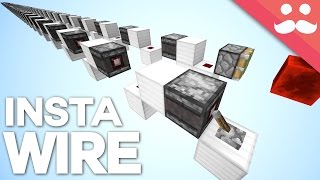
Video: Minecraft Revolution: Simple Pistonless Instant Wire (Screw you, Repeaters!) by Cubehamster
How to build it
- Check Your Directional Orientation
Press F3 to check your facing direction before building. This directional bug-based circuit requires the redstone torch of the detector to be oriented along the North/South axis (F=0 or F=2), while the signal entering the glowstone must come from the East/West axis (F=1 or F=3).
- Build the First Silent Glowstone BUD
Place your solid blocks, glowstone, redstone torch, and redstone dust to form the silent glowstone Block Update Detector module, making sure the torch and glowstone entry align with the cardinal directions checked in Step 1.
- Run the Redstone Wire Segment
From the output of the first BUD module, run a line of redstone dust across solid blocks as far as the signal strength reaches (up to 15 blocks). You can zigzag this wire in any direction to navigate around your build.
- Leave an Air Gap and Chain the Next Module
At the very end of the redstone line, leave a one-block air gap before placing the update-sensitive part of the next glowstone BUD module. Make sure the redstone dust points directly toward that empty space so firing the wire updates the air block.
- Repeat Across Your Desired Distance
Continue chaining wire segments and glowstone BUD modules with the one-block update gap for as many blocks as you need within loaded chunks.
- Connect Input and Output Devices
Attach a lever or button at the start of the first module. At the final module, connect a redstone lamp or hook up a sticky piston and block to convert the 1-tick output pulse into a T flip-flop toggle.
How it works
This circuit relies on a directional quirk in older Java Edition redstone involving Glowstone Block Update Detectors (BUDs):
- Directional BUD State: When a redstone torch and glowstone block are arranged in specific cardinal orientations (torch facing F=0 or F=2, glowstone powered from F=1 or F=3), the redstone wire enters a metastable state without needing any pistons.
- Air Block Updates: Redstone dust sends block updates two blocks away from its position when it changes state. Even though there is a physical air gap between the end of one wire segment and the next BUD module, powering or depowering the dust updates that empty air space, which immediately triggers the adjacent BUD.
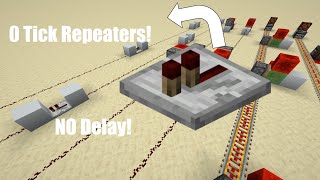
- Zero-Tick Chaining: Because block updates and dust state changes propagate within the same game tick without repeater or torch delays, every chained module updates simultaneously across thousands of blocks.
- Pulse Preservation: Toggling a lever sends a 1-tick pulse down the line (ideal for toggling a sticky piston T flip-flop), while pressing a button triggers an update on both the rising and falling edges, keeping the original button pulse length intact at the output.
Tips & variations
- Historical Version Note: This design was created in an older version of Minecraft Java Edition (circa 1.2) that used the
F: 0, 1, 2, 3debug direction system and a specific glowstone dust-redirection BUD glitch. This mechanic has been patched in modern versions of Minecraft. - Check F3 Directions First: If the BUD fails to trigger or clocks uncontrollably, rotate the detector module 90 degrees. The connecting transmission wires can snake around freely, as long as the entry into each glowstone BUD respects the cardinal constraint.
- Easy T Flip-Flop Output: Because each state change of a lever produces a clean 1-tick pulse at the end of the line, placing a sticky piston with a block at the output automatically turns the receiver into a zero-delay T flip-flop.
- Chunk Loading: While the wire works over thousands of blocks without lag, the entire line must remain inside loaded chunks to transmit the signal.