
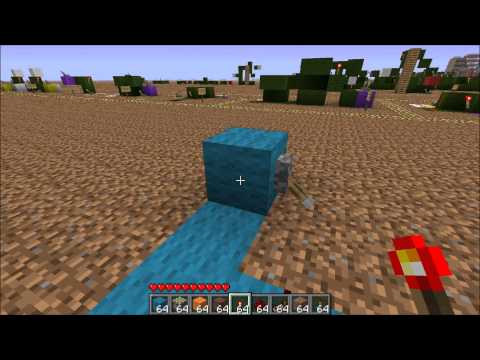
Video: How to make instant wire by TaviRider
How to build it
- Set up the input line
Place a solid block with a lever attached to it, then run a short line of redstone dust out from that block along the ground.
- Build the instant repeater frame
At the end of your input dust, place one solid block raised above the ground so the dust runs into it. Next to it in line, keep two ground-level spaces, and dig a one-block hole right after the first ground space.
- Place the reset and power torches
Place a redstone torch on top of the raised block. Then place a second redstone torch down inside the one-block trench you dug.
- Add the sticky piston and mobile block
Place a sticky piston against the forward-facing side of the raised block, facing along the direction of your wire. Place a solid block directly in front of the sticky piston head.
- Continue the output wire
Run your output redstone dust line along the ground starting directly after the pushed block. The underground torch powers the pushed block when extended, lighting up the output line.
- Chain multiple segments and test with note blocks
Repeat the module down the line whenever your redstone signal runs out. To verify it is truly instant, place a raised block with a redstone torch on top and a note block directly on top of that torch at each segment—when you turn the input off, all note blocks will chime as one simultaneous note.
- Optional: Convert to the burnout-proof reset
To run the wire on fast clocks without burning out the top reset torch, remove the top torch and dig out the ground beneath the retracted position of the mobile block as well, placing a torch in both underground spots. Place a block next to the new underground torch and a raised block beside the piston, then put two pieces of redstone dust on them to loop power back into the piston.
How it works
This circuit is a single-edge (falling-edge) instant repeater. It transmits the transition from powered to unpowered instantaneously down a chain of modules.
- Ready State: Each segment's output line is kept powered because the extended mobile block sits directly above an underground redstone torch, passing full power into the next redstone dust line.
- Instant Retraction (Falling Edge): Because a sticky piston begins retracting the very instant it loses power, turning off the first input line causes the first piston to immediately pull its block off the underground torch. That instantly cuts power to the next dust line, causing the second piston to start retracting in the exact same instant, cascading across all segments simultaneously.
- Automatic Reset: If the pistons stayed retracted, you would have to wait for each piston to sequentially extend on the rising edge before the wire could fire again. Placing a redstone torch on top of the block behind the piston creates an inverter: as soon as the input line turns off and the piston retracts, the top torch turns back on and immediately re-extends the piston into the ready position for the next pulse.
- Torchless Reset Variant: In the wider variant, a second underground torch sits below the piston's retracted block position. As soon as the piston pulls the block back, that block gets powered from below and sends a signal through two pieces of side redstone dust right back into the piston, immediately pushing it back out without relying on a torch that can burn out.
Tips & variations
- Testing with Note Blocks: Because the instant effect only happens when the wire turns off, connecting note blocks directly to the wire will play staggered notes (on the rising edge). Always invert the tap with a redstone torch underneath the note block so the note triggers on the instant falling edge.
- Torch Burnout Limit: The 1-wide design with the torch on top is compact, but if you hook it up to a rapid repeater clock (such as a two-repeater clock set to 3 ticks or faster), the top reset torch will fizzle and burn out, causing missed pulses.
- Maximum Clock Speed: Switching to the side-dust reset eliminates torch burnout entirely, allowing the wire to run reliably on a two-repeater clock set to the second delay notch (2 ticks per repeater). Running a 1-tick repeater clock is too fast for the pistons themselves to finish extending and retracting, which breaks the simultaneous instant timing.


