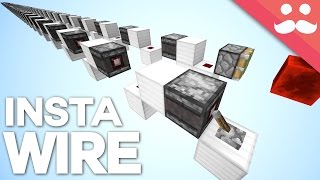
Video: Minecraft: Infinite Length Instant Redstone Wire by Mumbo Jumbo
How to build it
- Place the Input Trigger
Start by placing a button on a block connected to an initial piece of redstone dust. This dust will provide the very first block update to kick off the chain reaction.
- Build the First BUD Piston
Set up a Block Update Detector (BUD) using a sticky piston and a power source next to your input dust. Position it so that when the input dust changes state, it updates the piston and causes it to immediately extend.
- Run the Powered Redstone Line
Extend a line of redstone dust (up to 15 blocks long) that is normally kept powered by the first BUD setup. When the first piston extends, it should cut power or move the power source so this entire line of dust unpowers at once.
- Chain the Next BUD Module
At the end of your first redstone dust line, place a second BUD piston setup right next to the last piece of dust. When the first line unpowers, the state change of the dust will update and extend this second piston.
- Repeat for Infinite Length
Continue alternating between powered redstone dust lines and BUD piston modules for as far as you need the signal to travel. Connect the final unpowering redstone line to your output device.
How it works
This instant wire bypasses the 1-tick delay of redstone repeaters by taking advantage of how Minecraft processes block updates and unpowering redstone dust within the same game tick:
- Initial Update: Pressing the button powers the first piece of
redstone-dust. - BUD Activation: The state change of that dust causes a block update to the first
sticky-pistonconfigured as a Block Update Detector (BUD), making it extend immediately. - Instant Unpowering: When the piston starts moving, the
redstone-dustline behind it unpowers instantly. Unlike powering via repeaters, redstone dust unpowering happens with zero delay. - Chain Reaction: The unpowering of the dust at the end of the segment causes a block update to the next BUD piston in line, which starts extending in the exact same tick.
- Dual-Edge Output: Because the system triggers once when the button is pressed in and again when the button pops back out, the wire outputs two quick pulses (acting as a dual-edge monostable circuit).
Tips & variations
- Faster than a Torch: A signal traveling along this entire instant wire will arrive faster than a signal passing through a single 1-tick redstone torch inverter right next to the input.
- Dual-Edge Behavior: Keep in mind that a button press will fire the output twice—once when pressed and once when the button resets. If you only want a single state change, use a lever or filter the output.
- Java Edition Mechanics: This design relies on piston Block Update Detector (BUD) behavior and quasi-connectivity, which are exclusive to Minecraft Java Edition and will not work on Bedrock Edition.
- Chunk Loading: While the wire is theoretically infinite, all segments must remain within loaded chunks for the signal to travel from start to finish.