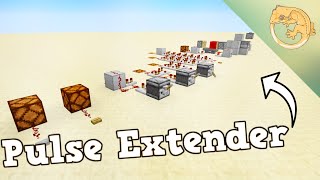
Video: Compact Pulse Extender - 1 Wide Tileable Adjustable - Minecraft Bedrock Edition by Telepathogen Media
How to build it
- Set Up the Input and Hopper Pair
Build a 1-wide frame of solid blocks and attach your input button or pressure plate to the front. Place two hoppers facing into each other inside the circuit so items can transfer back and forth between them.
- Add the Movable Tile Entity Mechanism
Position a sticky piston in line with the hoppers. Because Bedrock Edition allows pistons to push tile entities, this piston will shift one of the hoppers (or an adjacent control block) to control when items are allowed to flow and reset.
- Place the Comparator and Repeater
Place a redstone comparator reading the state of the primary hopper, and set a redstone repeater on its default 1-tick delay to carry the internal signal. It does not matter whether the comparator is left in standard compare mode or switched to subtract mode.
- Load Items to Set the Duration
Put your desired number of stackable items into the starting hopper. Hoppers move 2.5 items per second (one item every 4 redstone ticks), so 16 items will hold the output active for roughly 7 seconds.
How it works
This circuit operates as a modified, 1-wide tileable Etho-style hopper timer tailored specifically for Minecraft Bedrock Edition:
- Triggering the Cycle: When you press the input button, the initial pulse shifts the piston assembly and unlocks the main hopper, allowing items to begin draining into the second hopper.
- Sustaining the Output: While items are transferring, a
redstone-comparatorreads the inventory state and keeps the output signal turned on. Because a hopper transfers one item every 4 redstone ticks (2.5 items per second), the exact duration is determined purely by item count rather than input pulse length. - Resetting and Cooldown: Once the starting hopper empties, the comparator turns off and the piston retracts, allowing the items to flow back into the first hopper to prepare for the next press.
Tips & variations
- Bedrock Exclusive: This build relies on movable tile entities (pushing hoppers with pistons), which is a native feature of Bedrock Edition. It will not function in Java Edition without mods.
- Minimum Input Pulse: The input signal must be at least 3 redstone ticks long. Standard buttons and pressure plates (which output 10+ ticks) work automatically, but if you trigger it with an
observer(1-tick pulse), the circuit will glitch into a rapid clock unless you lengthen the observer pulse with a repeater first. - Not Resettable & Cooldown Time: Pressing the button again while the timer is running will not refresh the timer. Additionally, once the output turns off, wait for the items to finish draining back into the starting hopper; triggering it early will result in a shorter pulse.
- Alternate Output Reading: You can take your output from the opposite side of the timer to bypass the cooldown wait, though doing so will roughly double the output pulse duration.