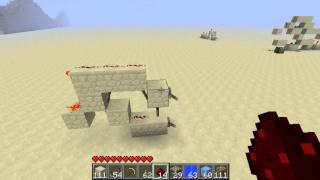
Video: Minecraft Logic Gates 11 - Compact D-Flip-Flop [Tutorial] by Sw1Ftx16
How to build it
- Place the Base Torches and Frame
Start by placing two redstone torches on the ground. Build a vertical T-shaped frame of solid blocks above and alongside them, adding one extra block extending off the end of the T.
- Add the Final Structural Block
Place one more solid block adjacent to your main frame to complete the support structure for the vertical latch and input lines.
- Attach the Latch Torches
Mount two redstone torches onto the front side of the block frame. Walk around to the back side and place another redstone torch, which will serve as your circuit's main output.
- Install the Control Torch and Wiring
Place one final redstone torch on the remaining side block. Along the top of the frame, lay down three pieces of redstone dust with a redstone repeater positioned in the middle, plus one more dust on the lower step.
- Add the Data and Clock Inputs
Attach a lever to the data input block and a button to the clock/write input block. Flipping the lever sets your data bit, and pressing the button writes that state to the output torch.
How it works
This circuit combines an input gating mechanism with a vertical RS NOR latch to store a single bit of data:
- Data Input (Lever): Toggling the lever prepares the input line as either ON (1) or OFF (0), but the signal is held back from reaching the memory latch while the clock line is idle.
- Clock/Write Input (Button): Pressing the button sends a pulse that temporarily unlocks the gating torches. This allows the current state of the lever to pass through the top repeater line and either set or reset the vertical RS NOR latch.
- Memory Latch & Output: Once the button turns back off, the vertical RS NOR latch remains locked in its new state, keeping the rear output torch stable regardless of how many times you flip the lever afterward.
Tips & variations
- Stacking for RAM: This design is easily stackable side-by-side (with a small gap or isolated lines so dust does not cross-connect). You can link all the button inputs to a single shared write line to store 4 bits (half a byte) or more simultaneously.
- Torch Burnout: Since this circuit relies on basic redstone torch inversions and a standard repeater rather than zero-tick pulses, it works reliably across both Java and Bedrock editions.
- Silent Operation: Because it uses only torches, dust, and a repeater without any pistons or droppers, this memory cell is completely silent.