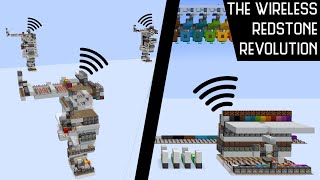
Video: 5 Ways to Make Wireless Redstone in Minecraft by Kevbotomy
How to build it
- Method 1: 1-Block Gap BUD Switch
Set up a Block Update Detector (BUD) using a piston or a comparator that is quasi-powered. Place a note block and a repeater facing toward it across a 1-block air gap; triggering the note block updates the BUD across the gap without connecting wires.
- Method 2: Frost Walker Transmitter
Place an armor stand equipped with Frost Walker boots between two sticky pistons with slime blocks. Wire the pistons so they bounce the armor stand back and forth toward the edge of your transmitter.
- Method 2: Ice Receiver
Leave a 2-block gap from the armor stand and place a water source block. Place an observer or BUD switch watching the water; when the armor stand moves closer, the water freezes into frosted ice and triggers your receiver.
- Method 3: Light-Level Transmission
Build an enclosed, pitch-black room out of tinted glass. Place a redstone lamp on one side as the transmitter, and plant wheat seeds on farmland on the other side with an observer or detector watching the crop.
- Method 3: Triggering the Light Receiver
Turn off the redstone lamp to drop the light level to zero, causing the planted seeds to uproot and pop off. You can optionally place a farmer villager inside with seeds to automatically replant the crop when the lamp turns back on.
- Method 4: Sculk Sensor Vibration
Place a sculk sensor at your receiver location and trigger a sound-producing block (such as a note block or piston) within its detection radius. The vibration travels wirelessly through the air to power your output.
- Method 5: Synchronized Daylight Clocks
For infinite-range wireless redstone, build two identical clocks—one at the transmitter and one at the receiver—using daylight detectors observed by observers powering redstone dust. Because all daylight detectors update on a global timer, both clocks will stay synchronized anywhere in the world.
- Method 5: Item Fall-Delay Receiver
Wire the receiver's synchronized clock to two droppers using repeaters so both droppers dispense an item in the exact same game tick in a controlled update order. Build a fall detector below them to check whether the two dropped items begin falling on the same tick or staggered ticks.
- Method 5: 3-Dropper Transmitter
At the transmitter, wire three top droppers to the synchronized daylight clock. Place three bottom droppers facing upward into those top droppers, and wire the bottom droppers to a push button.
- Method 5: Sending the Global Signal
Turn on both daylight clocks. Press the button on the transmitter to load items from the bottom droppers into the top three droppers; when the clock fires them on the exact same tick as the receiver's droppers, the global item-falling cycle shifts by three stages, causing the receiver's two items to fall together and trigger an output.
How it works
Each wireless method exploits a different Minecraft mechanic to bridge an air gap:
- BUD & Quasi-Connectivity (1-Block Gap): Java Edition pistons and comparators can be placed in an unstable state where they only react when an adjacent block updates, allowing a signal to jump a 1-block gap while allowing a separate redstone line to pass cleanly between them.
- Frost Walker (2-Block Gap): Moving an armor stand wearing Frost Walker boots within range of water turns it into frosted ice, which an observer detects as a block state change.
- Light Updates: Crops require light to stay planted. Turning off a redstone lamp inside a dark tinted-glass box causes seeds to pop off instantly at a distance.
- Sculk Vibrations: Sculk sensors emit a redstone signal whenever they detect sound vibrations within their radius.
- Global Item Entity Counter (Infinite Range): When multiple items are spawned into the world in the same game tick, Minecraft staggers when they start falling across a repeating 4-stage cycle (items 1, 2, 3, and 4 start falling on different ticks, while item 5 falls on the same tick as item 1). The receiver continuously drops two items on the same tick (normally slots 1 and 2, falling at different times). When the transmitter fires three items in between them on that same synchronized tick (taking slots 2, 3, and 4), the receiver's second item is pushed into slot 5. Because slot 1 and slot 5 fall on the exact same game tick, the receiver detects the simultaneous fall and outputs a redstone pulse across any distance.
Tips & variations
- Java Edition Exclusives: The BUD switch, quasi-connectivity, and the 4-stage global item falling mechanic rely on Java Edition update behavior and will not work on Bedrock Edition.
- Downward Daylight Transmission: For vertical wireless signals during the day, place two daylight detectors at the bottom of a shaft with a comparator in subtract mode, and use a piston high above to push a solid block over the sky access of one detector.
- Chunk Loading: If you use the infinite-range dropper transmitter for long-distance ender pearl stasis chambers, make sure the receiver chunk stays loaded with a chunk loader.
- Clock Alignment: Using an observer to read the redstone dust coming off the daylight detector clock allows the transmitter and receiver to fire on both the on and off edges, so they stay in sync even if turned on in opposite phases.