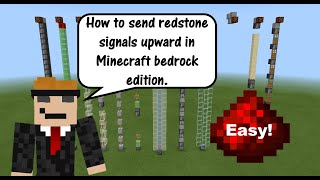
Video: Vertical Redstone Signals ( Upwards ) by IronSpiderFist
How to build it
- Method 1: Transparent Block Dust Ladder (Fastest)
Stagger transparent blocks like glass in a vertical zigzag or spiral pattern and place redstone dust on top of each block. Before the signal strength runs out after 15 blocks, insert a solid platform with a redstone repeater to boost the signal and continue upwards.
- Method 2: 2-Wide Dust and Observer Ladder (Fastest & Compact)
Create a 2-block-wide zigzag of transparent blocks with redstone dust on top. Instead of wide repeater platforms, place a vertical observer inline every 15 blocks to read the dust and push a fresh signal into the next section of the dust ladder.
- Method 3: Slime Block & Redstone Block Pillar
Place an upward-facing sticky piston at the bottom with 11 slime blocks stacked on top of it, followed by 1 block of redstone on the very top. Leave 1 air block above the redstone block, then place the next upward sticky piston and repeat the 11-slime-block pattern as high as needed.
- Method 4: Double Note Block & Observer Chain
Stack two note blocks vertically above your input, then place an upward-facing observer looking at the top note block. Repeat this pattern of two note blocks and one observer all the way to the top so each observer powers both note blocks above it.
- Method 5: Classic Redstone Torch Tower
Build an alternating column of solid blocks and upward redstone torches, placing a block directly above each torch and another torch on top of that block. Powering the bottom block turns off the first torch, which cascades the signal inversion up the entire 1x1 pillar.
- Method 6: Log and Leaf Update Pillar
Place an upward sticky piston holding a log or stem beneath a vertical column of 6 leaf blocks. Place an upward-facing observer directly on top of the 6th leaf block, followed by another sticky piston with a log and 6 more leaves, repeating to the top.
- Method 7: Scaffolding & Trapdoor Tower
Place a trapdoor at the bottom with a single supporting block structure so that a vertical pillar of scaffolding rests on top of the trapdoor. Place an upward-facing observer at the very top of the scaffolding pillar; toggling the bottom trapdoor updates the support state of every scaffolding block upward.
- Method 8: One-Time Plant Break Pillar
Grow a vertical column of twisting vines, bamboo, or sugar cane up to an upward-facing observer at the top. Place a piston at the bottom base of the plant; activating the piston breaks the bottom stem, causing the plant to break sequential blocks upward until the top observer detects it.
- Method 9: Item Bubble Column Elevator
Build an enclosed water bubble column elevator with an upward dropper at the bottom filled with items. At the very top of the water stream, place a piece of string with an observer watching it, plus a piston that pushes the detected item into a hopper.
- Method 10: Firework Rocket & Target Relay
Place an upward-facing dispenser filled with firework rockets at the bottom. Up to 20 blocks directly above it, place a target block with another upward dispenser on top of it so each rocket strike triggers the next stage.
How it works
Each vertical transmission method uses a different game mechanic to carry updates upward, resulting in distinct speeds:
- Redstone Dust Ladders (Methods 1 & 2): Redstone dust transmits power instantly up transparent blocks because transparent blocks do not cut off diagonal wire connections. Delay only occurs every 15 blocks where a repeater or observer (
1 redstone tick) refreshes the signal strength, making these the fastest methods overall. - Slime & Redstone Block Tower (Method 3): Pushing 11 slime blocks and 1 redstone block reaches the 12-block piston push limit. Each piston extension takes a brief moment to bridge the 1-block gap and power the next sticky piston, coming in second place for speed.
- Note Block & Observer Chain (Method 4): When an observer fires into a note block, it hard-powers that block and triggers the second note block above it at the same time. The next observer detects the upper note block changing state, covering 3 vertical blocks per 1-tick observer delay.
- Torch, Leaf, Scaffolding & Plant Towers (Methods 5–8): These four designs all travel at the exact same speed in the speed test. Torch towers invert power every 2 blocks. Leaf towers push a log into leaves, changing their distance tag up to 6 blocks away for the observer to read. Scaffolding towers propagate support distance changes block-by-block when the bottom trapdoor opens, and broken upward-growing plants break sequentially from bottom to top.
- Entity-Based Towers (Methods 9 & 10): The water elevator relies on a physical item floating up to trigger string in front of an observer, while the firework relay waits for a rocket entity to fly up to 20 blocks and strike a target block. These are the slowest methods.
Tips & variations
- Speeding up the Water Elevator: Instead of shooting an item up the water stream, place a dispenser with an empty bucket at the bottom of the bubble column and move the top observer down into the water column. Removing the bottom water source turns the bubble column back into normal water and propagates an observer signal much faster.
- Firework Relay Spacing: Keep the distance between the upward dispenser and the target block to 20 blocks or fewer. Spacing stations further apart makes the rocket trajectory unreliable and can cause the signal to miss the target block.
- Sugar Cane vs. Vines/Bamboo: Twisting vines and bamboo fit cleanly in a 1x1 footprint, while sugar cane requires an adjacent water block at the base to stay planted. Remember that plant-breaking towers are one-time use until replanted or regrown.
- Edition Note: Transparent blocks only pass redstone signals solely upwards on Java Edition, and sticky pistons dropping or pulsing blocks alongside note block observer updates behave differently on Bedrock Edition.