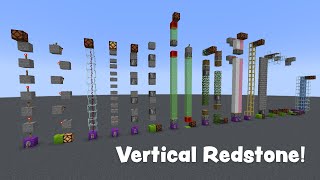
Video: How to send redstone signals upwards in minecraft bedrock edition by Spoonmuppet
How to build it
- Method 1: 1x1 Observer Chain
Stack observers directly on top of one another in a 1x1 vertical pillar with their faces pointing downwards and output dots pointing upwards. When the bottom observer detects a state change, the pulse travels straight up to the top without affecting any adjacent blocks.
- Method 2: Alternating Dropper & Observer Tower
To save quartz and increase speed over a pure observer chain, alternate droppers and upward-facing observers in a 1x1 vertical column. Each observer powers the dropper above it, which then triggers the next observer in the line.
- Method 3: Classic Redstone Torch Tower
Alternate solid building blocks and redstone torches straight up in a 1x1 column. Powering the bottom block turns off the torch above it, which unpowers the next block and inverts the signal step-by-step all the way to the top.
- Method 4: Glass Ladder with Piston Extender
Place glass blocks in a diagonal staggering staircase pattern and run redstone dust up the steps. When the signal strength runs low, place a sticky piston pushing a redstone block to refresh the signal and continue the glass ladder upwards.
- Method 5: Slime Block & Redstone Block Column
Use a sticky piston to push and pull a vertical column of slime blocks attached to a redstone block (up to the 12-block piston push limit). You can chain multiple segments vertically to send a fast, solid on/off signal upwards.
- Method 6: Soul Sand Bubble Column
Build a vertical tube filled with water source blocks and place an observer at the very top looking down into the water. Use a sticky piston at the bottom to slide a soul sand block under the water column, creating bubbles that the top observer detects.
- Method 7: Door & Observer Chain
For a cheap and fast pulse transmitter, alternate wooden doors and upward-facing observers in a vertical stack. Triggering a door updates both its upper and lower halves at once, allowing an observer at the top of the door to read the state change across two vertical blocks.
- Method 8: Piston & Sand Stack
If you do not have slime blocks yet, stack gravity-affected blocks like sand on top of a sticky piston or normal piston. Pushing the bottom block shifts the entire sand column upwards immediately, which an observer at the top can detect.
How it works
Each vertical transmission method uses a different game mechanic to carry a signal upwards:
- Block Update Chains (Observers, Droppers, Doors): An
observeroutputs a brief redstone pulse whenever the block in front of its face changes state. Stacking observers alone is compact (1x1) and works in both editions, but adds delay per block. Placing 2-block-talldoorsordroppersbetween observers stretches the signal across more vertical distance per observer, making the line faster and cheaper. - Signal Inversion (Torch Tower): A
redstone-torchturns off when the solid block it rests on is powered. Stacking alternating blocks and torches inverts the state at every level, sending a steady on/off signal straight up a 1x1 pillar. - Transparent Block Ladders (Glass & Dust): Transparent blocks like glass allow
redstone-dustto travel diagonally upwards without cutting the wire, and they only transmit power upwards rather than downward. - Physical Movement (Slime, Sand, Bubble Columns): Moving a line of
slime-blocks or sand shifts aredstone-blockor triggers an observer at the top almost instantly across up to 12 blocks. Similarly, sliding soul sand into a water column changes the water into bubble blocks all the way up for an observer to read.
Tips & variations
- Lag Reduction with Rails: Instead of long lines of redstone dust—which cause many lighting and block updates—you can alternate powered rails and observers to transmit signals with significantly less lag.
- Watch Surrounding Blocks: Redstone torch towers power adjacent mechanisms along the entire shaft, and slime block columns will grab any movable block touching them (breaking the 12-block push limit). Keep a 1-block air gap around slime columns, or use glazed terracotta/obsidian for walls.
- Bubble Column Reset Delay: Bubble columns send an upward pulse fairly quickly when soul sand is pushed in, but they take a noticeable amount of time to revert when the soul sand is retracted.
- Noise Considerations: The dropper-observer tower and door chain are very compact and survival-friendly, but they produce audible clicking or door sounds every time a pulse travels up the line.
- Alternative Fun Setups: The video also showcases creative concept transmitters using armor stands bounced on slime blocks into tripwire string, or items floating up water streams into waterlogged string observed at the top.