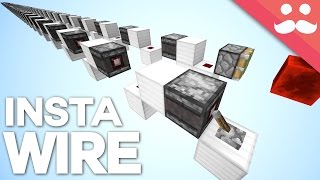
Video: Minecraft Redstone Dual Edge Instant Wire by Ray57a
How to build it
- Lay the Main Signal Line
Place a row of solid building blocks with Redstone Dust on top to form your primary transmission line. In the standard configuration, each repeater module is spaced 15 blocks apart.
- Build the TraviRider Base
At the end of the 15-block segment, set up the classic TraviRider instant repeater using a Sticky Piston and a solid block. Place a Redstone Torch underneath the piston position to supply power to the next segment when the block is moved into place.
- Add the Lava Block Edge Detector
Next to the repeater junction, construct the instant edge detector containment and place a Lava source block inside. This detector senses the incoming state change and provides an immediate 1-tick kick on the leading edge.
- Wire the Lower Blocking Signal
Run a secondary Redstone Dust line underneath the main line from the current module all the way up to the next instant repeater module. Place a Redstone Repeater along this lower line solely to extend the signal strength so it reaches the next module.
- Chain Additional Modules
Repeat the module layout every 15 blocks along your desired path (or every 14 blocks if building the thinner bus variant). Attach a Lever at the input end to test both rising and falling edges.
How it works
This circuit solves the one-tick delay found in single-edge instant wires by splitting the work between two mechanisms:
- Trailing Edge (Turning OFF): Handled by the classic TraviRider instant wire mechanism. Because piston retraction starts immediately when unpowered, breaking the connection over the subterranean Redstone Torch cuts power to the next line segment instantly.
- Leading Edge (Turning ON): A standard piston takes a tick before its pushed block can conduct power from the torch below. To bridge this gap, the Lava block acts as an instant edge detector, injecting a temporary 1-tick pulse into the output line the exact moment the input turns on. By the time that kick ends, the piston has finished extending to hold the signal high.
- Blocking Line: The lower redstone line with the repeater carries the blocking signal forward to the next instant repeater module, keeping the detector synchronized across a 3-tick cycle.
Tips & variations
- Thinner Bus Variant: If you want to pack multiple lines side-by-side into a data bus, you can rearrange the wiring to make the module thinner. Doing so shortens the distance between repeaters from 15 blocks down to 14 blocks.
- Cycle Speed: This wire is stable at a 3-tick cycle. Pulsing the input faster than 3 ticks can desynchronize the lava detector and the lower blocking repeater line.
- Edition Note: Instant wire mechanics rely heavily on Java Edition update order and piston zero-tick/update behaviors, and will not function in Bedrock Edition.