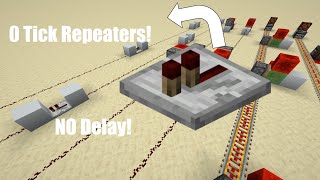
Video: Very Compact, Long Distance, Dual-Edge InstantWire by SethBling
How to build it
- Build the Input Dual-Edge Detector
At the start of your line, construct two toggleable block update detectors (BUDs) connected to your input lever. Arrange the two pistons and their movable blocks so that one block is always extended while the other is retracted.
- Wire the Pulse Generator Output
Place a redstone torch underneath the extended position of each of the two detector blocks. Connect the output of both positions into a single redstone dust line so that toggling the input instantaneously retracts the active block and briefly depowers the line before the other piston finishes extending.
- Construct the Compact Instant Repeater Line
Along your transmission path, build a chain of single-line pulse instant repeaters every 15 blocks. For each module, place a solid block with a redstone torch on top, a sticky piston facing forward holding a solid block, and another redstone torch in a pit directly underneath the block's extended position.
- Link the Instant Wire Modules
Run a single line of redstone dust from the output of one module to the base block of the next module in the chain. Repeat this compact module for as far as you need the signal to travel.
- Connect the Output Dual-Edge Receiver
At the end of the long-distance pulse line, feed the final redstone dust line into a standard dual-edge instant repeater unit. Every instant off-pulse arriving from the wire will trigger a single block update and toggle the receiver's output state, matching your input lever immediately.
How it works
Instead of building a massive dual-edge instant repeater every 15 blocks, this circuit separates the system into an encoder, a thin pulse transmission line, and a decoder:
- Dual-Edge Encoding: The input device uses two opposing piston states with redstone torches underneath their extended positions. Because piston retraction is instantaneous while extension takes time, flipping the lever in either direction causes whichever piston is currently extended to retract immediately.
- Instant Off-Pulse: That instant retraction cuts power from the torch beneath it before the opposing piston can finish extending over the other torch. This creates a brief off-pulse on the main line on both the rising and falling edges of the input.
- Single-Line Transmission: Each compact inline repeater consists of a torch on a block powering a piston over a bottom torch. When the input line briefly depowers, the piston retracts its block instantly, uncovering or cutting off the signal to the next segment with zero delay down the entire chain.
- Output Toggling: The receiving dual-edge instant repeater at the destination acts like an instant T flip-flop. Each brief pulse from the transmission line causes one update, toggling the output between steady ON and steady OFF in exact sync with the input switch.
Tips & variations
- Long-Distance Efficiency: You only need the wider dual-edge mechanisms at the very beginning and very end of the wire; the entire middle span is just a 1-wide line of redstone dust and small piston modules.
- Testing Sync: Place a note block at the start and end of your line (or loop the wire back to the start) to verify that both signals fire on the exact same tick when turning the lever on and off.
- Java Edition Mechanics: This design relies on Java Edition instant piston retraction and block update detector (BUD) behavior, and will not function the same way in Bedrock Edition.