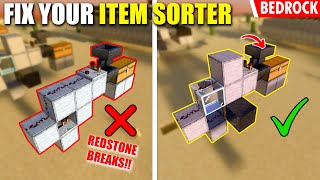
Video: Lag-friendly item sorting system with overflow protection by ike
How to build it
- Build the 1-wide support frame
Construct a 1-block-wide vertical frame out of solid building blocks shaped like a downward-sloping diagonal staircase with a central block and lower lip to hold the components.
- Place the filter comparator
On the top rear platform of the frame, place a redstone comparator facing toward the back of the slice so it will read from the filter hopper.
- Add the single redstone dust
Behind that first comparator, place a single piece of redstone dust on the block that the comparator runs into.
- Install the empty dropper and second comparator
Underneath the block holding the redstone dust, place an empty dropper against the central solid block. On the opposite side of that solid block, place a second comparator facing away from the block so it reads the dropper through the block.
- Attach the locking redstone torch
Place a redstone torch on the front lower block of the frame so it sits below the output path of the second comparator and locks the lower output hopper by default.
- Place the filter and output hoppers
Place your lower hopper next to the redstone torch pointing into your storage chests, then place the filter hopper above it pointing into the first comparator.
- Configure the non-stackable item filter
Open the filter hopper and place 4 non-stackable items (such as wooden swords) into the last four slots. Put the item you want to sort into the first slot—it will safely fill up to 63 items and sort every 64th item.
How it works
This circuit exploits a lesser-known comparator priority rule in Minecraft:
- Container Priority Through a Block: When a comparator faces away from a solid block that has a container (like an empty dropper) right behind it, the comparator reads the inventory of the container through the block and ignores any redstone power level on the block below 15.
- Signal Strength 15 Override: Only when the solid block is hard-powered to a full signal strength of
15does the second comparator stop reading the empty dropper and output a signal instead. - Zero Cross-Slice Interference: In the filter hopper, the last four slots hold non-stackable items, and the first slot holds up to 63 of the sorted item. As SOON as the 64th item enters, the hopper is 100% full and the top comparator outputs signal strength
15into the single redstone dust. - Adjacent Isolation: Even though the redstone dust lines connect across neighboring slices, adjacent slices only receive a maximum signal strength of
14or less from a neighbor firing. Because the lower comparator requires strictly15to override the empty dropper, neighboring slices never trigger one another. - Unlocking the Hopper: When the second comparator turns on at strength 15, it powers the block holding the redstone torch, briefly turning the torch off and allowing the lower hopper to pull the 64th item into storage.
Tips & variations
- Why a Dropper Instead of a Furnace? While furnaces also work as the behind-the-block container, inactive droppers are much more performance-friendly because they do not tick or search for recipes when idle. Keep the dropper completely empty.
- Torch Burnout is Normal: If a massive burst of the exact same item enters one slice continuously, the redstone torch may temporarily hiss and burn out. Do not worry—while the torch is burned out (off), the lower hopper remains unlocked and drains items at full hopper speed without letting the filter empty below 63 items.
- Filter Buffer Cost: Because this design triggers at signal strength 15, the first slot of the filter hopper must hold 63 items of the sorted type alongside 4 non-stackable items. Use cheap non-stackables like wooden tools or leather armor for the last four slots.