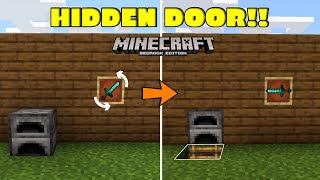
Video: Tiny Minecraft Hidden Staircase to Hide your Base! 1.16+ by Kwipla
How to build it
- Dig the Pit and Place the First Block Swapper
Choose where your top stair will sit at floor level and clear a pit 11 blocks wide, 6 blocks long, and 5 blocks deep beneath it. Two blocks below the first stair position, place an upward-facing sticky piston with the stair on top. Place two normal pistons facing inward on either side at floor storage level: one with a 1-block gap on the right and one with a 2-block gap on the left.
- Wire the First Layer (Left Side & Target Block)
Place your input lever on a solid block underneath the right-hand normal piston. On the opposite side of the central sticky piston, build a diagonal stair-step of solid blocks going out and up. Run a repeater out from the lever block into redstone dust, followed by a repeater set to 3 ticks (corrected from 2 ticks), two dust up the blocks, a target block above the repeater, and a 1-tick repeater facing back toward the center.
- Add the Observer & Hopper Timing Chain
Place a hopper pointing into the block holding the left-side repeater, with an observer reading that hopper and pointing left into a second hopper. Read the second hopper with an observer pointing toward the back, place a note block to its left, and run a U-shaped chain of four observers (two going back, two coming forward) ending right underneath the input lever.
- Finish the First Layer Dropper-Hopper Circuit
To the right of the lever, place redstone dust, a solid block with a redstone torch on its side, and two repeaters set to 3 ticks looping through redstone dust where the observers meet. Above the observer near the torch, place a block with dust on top, a dropper facing toward the lever side, and a hopper feeding back into the dropper with 1 dummy item inside. Place a comparator reading the dropper above the lever block, crouch-place a switched-on lever or block on the observer as shown to prime it, and place your stair and floor block in front of the normal pistons to test the first swap.
- Build the Second Stair Layer
Behind the first vertical sticky piston, step down and place the next upward-facing sticky piston with a stair on top. Place a slab diagonally below it above the hopper with redstone dust on top, and add two opposing normal pistons behind the first pair to swap the second floor block and stair. Place a target block under the left normal piston and a repeater on top of the dropper pointing into the right normal piston.
- Wire the Third Stair Layer and Double Extender
Where the hopper and block meet on the left, attach a redstone torch so it turns off, then place a vertical stack of two sticky pistons in front of it with the third stair on top. Add the third pair of opposing normal pistons at the sides. Wire the left side with two blocks and redstone dust, and wire the right side using a redstone lamp, a solid block, dust, and a repeater pointing into the structure.
- Add the Right-Side Pull-Down Observer Chain
Underneath the right-side normal piston by the target block, add another normal piston below it to handle the lower storage position. Place two observers underneath—one pointing straight down and one pointing to the left—so the floor block gets pulled down cleanly when opening.
- Build the Folding Triple Piston Extender (Right Side)
On the back-right side near the green circuit blocks, place a sticky piston facing forward holding a redstone block, with another sticky piston right above it and a normal piston tucked in the gap next to the observer. Run two observers underneath pointing back, leading into redstone dust on a block next to a redstone lamp. Chain an observer, a note block, and another observer upward from the lamp to power a folding cluster of one normal piston (pointing left on top of the lamp) and three sticky pistons (one in front of the observer, one in front of the normal piston, and one pointing straight up with the final stair).
- Complete the Left Pushback Circuit
On the back-left side, place a solid block against the exposed observer output and mount a normal piston above it pointing toward the center. From the back redstone lamp, run three observers (one pointing back, two pointing right) into a repeater and two redstone dust on solid blocks. Place an immovable block such as a furnace or obsidian at the stop point, fill in your floor blocks, and flip the lever to test the full synchronized staircase.
- Connect Inside and Outside Buttons (T Flip-Flop)
To trigger the staircase with buttons from both inside and outside, remove the test lever and place a solid block with a repeater pointing into the circuit and a redstone block in front of the repeater. Set up two sticky pistons facing each other with a gap between them to push the redstone block back and forth, driving the back sticky piston through an observer pointing into its rear. Wire both your outside and inside buttons directly into that back observer-piston input.
How it works
This hidden staircase divides the work into four vertical slice layers that fire in sync so the floor tiles retract and the stairs pop up at the exact same moment:
- Block Swapper Layers (Stairs 1–3): The first three slices use pairs of horizontal regular pistons to shift either a solid floor block or a stair block over a vertical sticky piston column. A dropper-hopper memory cell with a single item and comparator holds the state for the upper swapper, while target blocks seamlessly redirect redstone dust into the side pistons without needing wide wiring loops.
- Constant Powering: Several pistons remain powered in the closed or open state and update via redstone lamps, note blocks, and observer lines. Keeping the lines constantly powered prevents random block-update glitches that broke older designs.
- Folding Triple Piston Extender (Stair 4): Because the deepest stair must travel three blocks vertically while the displaced floor block is tucked out of the way, the back layer uses a folding mechanism. A sticky piston moves a
Block of Redstonewhile an observer-and-note-block chain sequences a horizontal normal piston and vertical sticky pistons, folding the floor block down into the base wall and extending the bottom stair up into place. - Piston T Flip-Flop Input: pulsing the back observer spits the redstone block back and forth between two sticky pistons, converting a short button press from inside or outside the base into a permanent open or closed state.
Tips & variations
- Repeater Timing Check: Make sure the repeater on the far-left of the first layer (the blue circuit) is set to 3 ticks, not 2 ticks. Setting it to 2 ticks will cause the first block swapper to mistime.
- Use a Dropper, Not a Dispenser: The item-holder in the first layer must be a dropper feeding into a hopper. A dispenser will try to use or shoot out certain items instead of transferring them cleanly.
- Immovable Stop Block: Do not forget to place a
FurnaceorObsidianblock on the back-left pushback circuit so the piston line stops in the right alignment. - Java Edition 1.16+ Only: This build relies on Java piston spitting (1-tick pulses dropping blocks), quasi-connectivity, and 1.16+
Targetblocks to redirect dust. It will not function on Minecraft Bedrock Edition. - Hiding the Input: Instead of an exposed button, you can hook the T flip-flop input up to a hidden redstone torch key on the floor above for a completely invisible entrance.