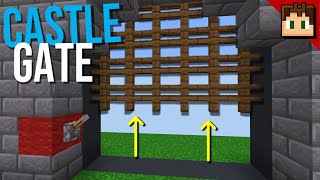
Video: Minecraft Working Castle Gate | Java & Bedrock Customisable Medieval Fantasy Gate by Jax and Wild
How to build it
- Dig the Foundation Pit
Clear a 10x6 pit that is 4 blocks deep so you have room to wire the underground extender. The bottom-left corner of this area will be the base of your 4-wide castle gate.
- Place the Bottom Pistons
In the bottom-left trench, place a row of 4 upward-facing sticky pistons. Directly on top of those sticky pistons, place a row of 4 upward-facing regular pistons.
- Wire the Lower Extender Base
Place 4 redstone repeaters facing into the bottom row of sticky pistons and run a line of 4 redstone dust behind those repeaters. Place solid building blocks right over the repeaters and over the first 3 pieces of redstone dust, leaving the last dust uncovered.
- Add the Observer and Upper Row Repeaters
Crouch and place an observer on top of the exposed end so its face looks down at the redstone dust and its output dot points straight up. Place 4 repeaters on top of the blocks covering the lower repeaters, then run redstone dust behind them starting from the top of the observer.
- Set Up the Open and Close Control Blocks
Leave a one-block gap above the lower wiring level and place a Red Wool block (close) next to a Green Wool block (open) on the wall face. Place a building block with a dot of redstone dust directly underneath the Green Wool.
- Connect the Open Button to the Bottom Extender
Build a small staircase and L-shaped bridge of blocks from underneath the Green Wool down to the bottom repeater line. Place repeaters and redstone dust along this path so pressing a button on the Green Wool powers the bottom row of repeaters and triggers the observer.
- Build the Redstone Torch Tower
On top of the Red Wool (close button block), build a vertical torch tower alternating 3 redstone torches and 3 solid blocks straight up. At the top, place a block with redstone dust powering an upward-facing regular piston with a falling block (sand, gravel, or concrete powder) resting on its head.
- Add the Top Pulse Generator
Next to the resting position of the raised falling block, place a repeater set to 3 ticks (two clicks) running into a horizontally facing sticky piston holding a Block of Redstone.
- Wire the Upper Double Piston Extender
Next to the extended Block of Redstone position, build two 4-wide shelves of building blocks—one level with the redstone block and another two blocks below it. Run 4 redstone dust along the back of each shelf and 4 repeaters facing forward on each shelf; keep the top repeaters on 1 tick and set the bottom row of repeaters to 3 ticks.
- Install the Downward Pistons
In front of the two upper repeater shelves, place a row of 4 downward-facing regular pistons at the top, and another row of 4 downward-facing regular pistons directly beneath them.
- Fill the Gate and Gravel Buffer
Stack two rows of gravel on top of the lower pistons in the floor trench. Above the gravel, build your 4-wide by 3-high castle gate out of iron bars or solid blocks, capped with a single row of solid blocks right under the upper downward-facing pistons.
- Wire the Inside Buttons
Extend two parallel lines of blocks through your castle wall from the back of the Red and Green Wool blocks to the interior side. Use redstone repeaters rather than parallel redstone dust so the two lines do not cross-connect, and place matching Red and Green Wool with buttons on the inside.
How it works
This castle gate works by opposing two non-sticky double piston extenders against a column of gravity-affected blocks:
- Opening the Gate (Green Button): Pressing the green button sends a pulse to the underground extender. The bottom row of sticky pistons pushes the regular pistons upward, while the
observerdetects the state change and fires the upper row of repeaters a moment later. This double-extends the gravel upward, pushing the 4x3 gate up into the top frame—which simultaneously pushes the upper downward-facing pistons back into their retracted housing. - Closing the Gate (Red Button): Pressing the red button sends a signal up the 3-torch vertical inverter tower. At the top, the upward-facing piston briefly drops and re-pushes the falling block (concrete powder/sand), sending a shortened pulse through a 3-tick repeater into the sticky piston holding the
redstone-block. - Upper Double Extension: The Block of Redstone powers two tiers of repeaters simultaneously: the top row on 1-tick delay and the lower row on 3-tick delay. The upper regular pistons push the lower regular pistons down first, and the 3-tick delayed row fires right after to push the gate down two full blocks. The gravel beneath the gate falls back down with gravity as the lower extender sits retracted.
Tips & variations
- Customize the Gate Blocks: Because regular pistons push the top cap and gravel pushes from below, the 4x3 gate area can be made of iron bars, fences, walls, stone bricks, or mixed blocks to look like a medieval portcullis, futuristic door, or garage door.
- Don't Use Non-Gravity Blocks at the Base: The blocks immediately on top of the bottom piston stack must be gravity blocks (gravel, sand, or concrete powder) so they naturally fall back down when the gate closes.
- Prevent Wire Crosstalk: When extending the open and close buttons to the inside of your castle wall, always separate the two adjacent 1-wide channels with repeaters so the redstone dust lines do not link together.
- Java & Bedrock Timing: Make sure the top pulse repeater and the lower shelf of the upper extender are both set to 3 ticks (two clicks after placement) for reliable operation across both editions.