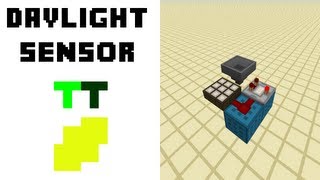
Video: Working Redstone Clock Tutorial V2 | Minecraft (Java Edition 1.19.2+) by Snap2it
How to build it
- Build the Clock Face and Hand Slots
Place a glowstone block at the center and extend temporary blocks 4 blocks out in each cardinal direction to frame the outer rim with polished andesite, stairs, and slabs. Fill the inner face with smooth quartz and chiseled quartz around the center, leaving eight 2-block-long indents radiating from the center for the clock hands. Cover the center glowstone with a trapdoor and place 4 polished blackstone walls in the inner diagonal corners.
- Install the Clock Hand Sticky Pistons
Go behind the clock face and place temporary blocks 2 blocks back behind every 2-block slot. From the front, place sticky pistons facing forward into each of the eight hand slots against those temporary blocks, then remove the temporary blocks behind them.
- Wire the 3-Tick Display Ring
Behind the sticky pistons, build the connecting frame using solid blocks, placing 2 target blocks and one required glass block on the upper side to prevent cut wires. Place redstone repeaters set to 3 ticks along each step of the ring and link them to the sticky pistons with redstone dust.
- Add the 2-Tick Reset Feed Line
Behind the 3-tick repeater ring, place a line of blocks feeding into each position. Add a 1-tick repeater at the first entry block and set the remaining repeaters along this secondary line to 2 ticks, finishing with a sideways sticky piston at the end.
- Build the Glass Zigzag Tower and Target Cutoff
Construct a lower support line and a vertical zigzag tower of glass blocks above the sideways sticky piston. Run redstone dust up the glass tower and along the bottom line with two 1-tick repeaters, then place a redstone torch at the bottom to power the line and extend the piston with a target block on top of it.
- Connect the Daylight Detector
Place a glass block with redstone dust behind the piston, and add a block with a second redstone torch below to power the lower line. At the top of the circuit, place a daylight detector connected by exactly 4 blocks of redstone dust leading into the reset line.
- Build the First Hopper Timer
At the bottom of the circuit, add a 4-tick repeater and a 2-tick repeater leading into the lower torch block. Build the first Etho hopper clock using two hoppers facing into each other, two comparators reading them into blocks with redstone dust, and two sticky pistons pushing a block of redstone back and forth. Fill the hoppers with 2 stacks plus 60 of any 64-stackable item (188 items).
- Add the Observer and Piston Switching Logic
Above the first hopper clock, place a downward-facing observer looking at the moving redstone block, along with a horizontal sticky piston holding a solid block and a downward sticky piston with a second block of redstone. Wire a glass block, solid blocks, redstone dust, and a comparator above them to control the clock cycle.
- Wire the Middle Note Block Bridge
Between the two timer sections, build the bridge circuit using two 1-tick repeaters, an observer, a target block, a comparator, and a note block with a sideways sticky piston underneath it. Add two blocks above with redstone dust and a 2-tick repeater to connect the pulse to the upper logic.
- Build the Second Hopper Timer
Two blocks over from the first hopper clock, build an identical second hopper clock using two hoppers facing each other, two comparators, two sticky pistons, and a block of redstone. Place another 2 stacks plus 60 stackable items (188 items) inside this second pair of hoppers.
- Finish the Second Timer Observer Logic and Clock Face
Add the downward observer, horizontal sticky piston, downward sticky piston with a block of redstone, a 2-tick repeater, and an upward-facing observer on glass with a comparator on top. Finally, return to the front of the clock and fill all eight 2-block hand slots with smooth quartz blocks right onto the sticky piston faces.
How it works
This circuit combines a dual-stage Etho hopper clock with a sequential repeater memory ring and a daylight detector reset line:
- Timekeeping (Dual Hopper Clocks): Each hopper clock contains 2 stacks and 60 items (188 items). As items transfer back and forth, the comparators flip the sticky pistons and move a
block of redstoneunderneath a downward-facingobserver. The two linked hopper clocks divide the 20-minute Minecraft day into discrete steps that advance the hour hand twice around the clock face every 24 in-game hours. - Hand Display Ring: The eight 2-block-long quartz hands are pushed flush with the clock face or retracted by sticky pistons arranged around the center. A ring of 3-tick
redstone repeaterspasses the active state sequentially from one hand position to the next, whiletargetblocks redirect redstone dust into pistons that aren't directly aligned with the wire. - 6:00 AM Sleep Resynchronization: The
daylight detectormonitors the sky light level through a 4-dust signal-strength wire. When a player sleeps in a bed and wakes up at 6:00 AM, the sudden jump in daylight signal strength reaches the threshold at the 4th redstone dust. This triggers the secondary 2-tick repeater chain and temporarily retracts thetargetblock cutoff via the sticky piston, clearing the current hand position and resetting the timer to the 6:00 AM slot.
Tips & variations
- Daylight Detector Distance: The daylight detector must be connected to the trigger input by an effective distance of 4 redstone dust so that the morning light level triggers at exactly 6:00 AM. If your clock tower roof forces you to place the sensor further away, place a
redstone comparatorright after the daylight detector (or along a full-strength wire) to preserve the signal strength, then count 4 pieces of redstone dust from the comparator output. - Keep the Sensor Unobstructed: Never place solid opaque blocks above the daylight detector, or its sky light reading will be offset. Only use transparent blocks like glass above it, or leave it completely open to the sky.
- Build in Spawn Chunks: Like any redstone timer, the hopper clocks pause if the chunks unload while you explore or visit the Nether. Building the clock inside your world's spawn chunks keeps it running continuously, and if it ever desynchronizes, sleeping in any bed will automatically reset it.
- Java Edition Only: This circuit relies on Java-specific piston timings and update order and will not function reliably on Bedrock Edition.