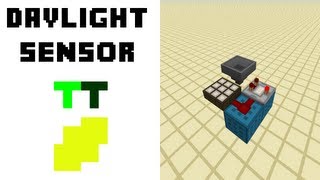
Video: Redstone Academy - Daylight Sensor - Single Pulse - [ Java 1.28+ ] by Minecraft Tutorials
How to build it
- Place the Daylight Detector
Start by placing your daylight detector on the ground where it has unobstructed access to the sky. Leave it in its default daylight mode.
- Add the First Repeater
Place a redstone repeater facing away from the daylight detector to take its output. You can leave it on its default 1-tick delay.
- Position the Piston
Dig one block down right in front of the repeater and place a piston facing upwards. The repeater should be pointing into the space directly above the piston head.
- Place the Conductive Block
Place a solid block on top of the upward-facing piston. If you used a sticky piston, any solid conductive block works; if you used a regular piston, use a gravity-affected block like sand or red sand so it falls back down at night.
- Connect the Output
On the opposite side of the solid block, place your second redstone repeater facing away from the block. Place a redstone lamp (or connect your farm's redstone line) in front of this second repeater to test the morning pulse.
How it works
This circuit functions as a classic rising-edge monostable circuit (pulse limiter) triggered by sunlight:
- Nighttime (Reset State): When it is dark, the daylight detector outputs no power. The upward-facing piston remains retracted, keeping the solid block directly between the two repeaters.
- Sunrise (Pulse Generation): As soon as morning arrives, the daylight detector sends a signal into the first
redstone repeater. The repeater powers the solid block in front of it, which immediately sends power into the second repeater on the other side, turning on your output. - Signal Cutoff: At the exact same time, the powered block activates the piston beneath it (or the repeater powers the piston directly depending on elevation). The piston extends and pushes the block upward, breaking the connection between the two repeaters after just a brief moment.
- Daytime Hold: The piston stays extended for the rest of the day, preventing any further signal from passing through until night falls and the piston retracts the block back into position.
Tips & variations
- No Slimeballs Required: If you are building this early in survival mode and don't have a sticky piston, use a regular piston with sand, red sand, or gravel on top. Gravity will pull the block back down at night when the piston retracts.
- Nighttime Pulse Variant: If you right-click the daylight detector to invert it (turning it blue), the circuit will instead emit a single pulse every evening as night falls.
- Adjusting Pulse Length: You can slightly adjust the timing of the pulse by changing the tick delay on the repeaters to suit devices that require a longer activation signal.