
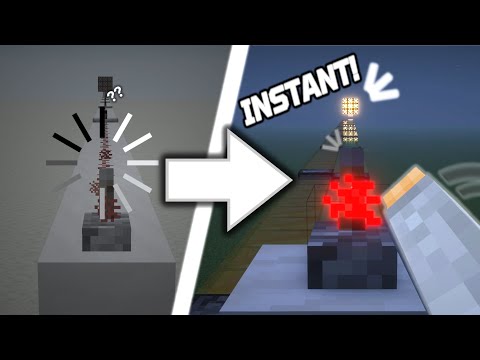
Video: How to Make the BEST Instant Wires in Minecraft by ChunkySquares
How to build it
- Downwards Wire: Build the Wall Column
Stack any type of wall block vertically from your top input height all the way down to your output level. Make sure there are blocks placed adjacent to the wall so it connects into a flat state rather than a center post.
- Downwards Wire: Add Input and Output
Place a trapdoor against the side of the very top wall block alongside your input lever or button. At the very bottom of the wall pillar, place an observer facing the bottom wall block to read the shape update and output a pulse.
- Upwards Wire: Build a Water Source Tower
Construct a vertical tube to hold water and fill every block from bottom to top with water source blocks. Leave space at the base of the water column to swap the floor block.
- Upwards Wire: Set Up the Soul Sand and Magma Swapper
Place a Soul Sand block and a Magma Block next to each other at the bottom of the water column, attached to a sticky piston setup. Wire your input so toggling it pushes one block beneath the water column while pulling the other away.
- Upwards Wire: Place the Top Observer
At the top of the water column, place an observer looking directly into the highest water source block. Whenever the floor swaps between Soul Sand and Magma, the bubble column state changes instantly and triggers the observer.
- Horizontal Wire: Build Dual Piston Chains
For horizontal travel, build two parallel lines of sticky pistons pushing lines of slime blocks with a Block of Redstone at the end of each segment. Each Block of Redstone powers the next sticky piston in the chain.
- Horizontal Wire: Set Up Opposite Inputs
Wire the input so that one piston line is fully extended while the circuit is off, and the second line is retracted. Because piston chains extend slowly but retract instantaneously, one line handles the instant ON signal by retracting, and the other handles the instant OFF signal.
- Horizontal Wire: Link the Lines to Reset Each Other
Connect the two parallel chains at every segment using monostable circuits (using pistons, comparators, or observers). When one line retracts instantly, it triggers the monostable circuits along its length to push all pistons of the opposite line back into their ready state simultaneously.
How it works
Each direction relies on a different instant-update mechanic in Minecraft:
- Downwards (Wall Updates): When a trapdoor opens or closes against the top of a wall column, the top wall changes its block state (adding or removing a center post). All wall blocks directly underneath update their state in the exact same game tick, regardless of height.
- Upwards (Bubble Columns): Creating a bubble column from regular water has a delay, but destroying or swapping an existing bubble column updates the entire water pillar instantly. By swapping a
Magma BlockandSoul Sandwith a sticky piston, you are always removing an active bubble type, causing the top water block to change state in 0 ticks. - Horizontal (Differential Piston Pairing): A chain of sticky pistons, slime blocks, and redstone blocks takes time to extend because pistons take time to push, but it retracts instantly when power is cut. By pairing two lines together, each state change uses the instant retraction of one line to transmit the signal while simultaneously firing monostable circuits at every node to reset the parallel line in place, eliminating cooldowns.
Tips & variations
- 1-Wide Tileable Vertical Wires: Both the downwards wall wire and upwards bubble column wire can be placed directly side-by-side. For adjacent bubble column swappers, alternate between
Slime BlocksandHoney Blocksso neighbouring piston mechanisms do not stick together. - Compact Horizontal Variants: You can replace the bulky piston monostable reset circuits with comparator monostable circuits to save space while staying 100% spam-proof. An even smaller variant uses observers and quasi-connectivity to update the pistons, though it can lose sync if spammed too quickly.
- Edition Note: The horizontal observer variant relies on quasi-connectivity and instant piston retraction chains, which are Java Edition mechanics.


