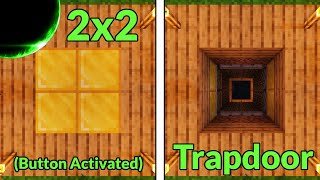
Video: Minecraft Bedrock: 4x4 FLUSH TRAPDOOR Tutorial! 1.21 by Tomco
How to build it
- Clear the 10x8x3 Area
Dig out a 10x8 rectangular pit that is 3 blocks deep below your floor level. Mark the exact 4x4 center where the trapdoor opening will sit so you can align the mechanism properly.
- Place the Slime and Honey Strips
Step down below the outer edges of the 4x4 opening. On one side, place a row of 4 honey blocks with a row of 4 slime blocks right next to it, retracted away from the center. On the opposite side, mirror this in reverse order (4 slime blocks next to 4 honey blocks) so opposing colors never stick carelessly.
- Install Horizontal and Vertical Sticky Pistons
Two blocks behind each slime/honey group, place a row of 4 horizontal sticky pistons facing inward toward the slime and honey blocks. Then, beneath the front edge of the slime and honey rows, place 2 upward-facing sticky pistons on each side (4 vertical sticky pistons total).
- Add Door Blocks and Floor Ceiling Stoppers
Place your 16 floor blocks directly on top of the slime and honey blocks. Next, build the surrounding fixed floor so that every single retracted door block currently sits directly underneath a solid floor block—this is required to overload the piston push limit during retraction.
- Wire the Outer Redstone Dust Perimeter
Along the two long sides of the pit, place redstone dust in a pattern of two dust, a one-block gap, one dust, a one-block gap, and one dust. Place solid blocks into those gaps with redstone dust on top, then connect both ends with continuous lines of redstone dust along the short sides.
- Set Up Target Blocks and Repeaters
At all four corners next to the upward-facing sticky pistons, place a target block. Put a repeater on top of each target block facing into the slime or honey, set to 3 ticks. Facing away from each target block, place a 1-tick repeater running into a solid block.
- Build the Observer Push-Down Triggers
Choose one end of the perimeter wire for your lever input. Above the middle of that side, place two top slabs with redstone dust on them, flanked by two inward-facing sticky pistons holding observers that face toward the trapdoor.
- Add the Downward Regular Pistons
Next to those sticky pistons, place a solid block on each side with a regular piston facing downward beside it. Put an observer on top of each regular piston running into a block with redstone dust to trigger the horizontal sticky pistons.
- Complete the 3-Tick Observer Return Timing
On the opposite side of the assembly, place a solid block with a 3-tick repeater leading into an upward slab with redstone dust on top. Place an observer facing into that block on both sides so it fires at the right moment during closing.
- Line the Walls with Non-Stick Blocks
Build a 2-block-high inner wall of glazed terracotta, obsidian, or shulker boxes along the two sides where the slime and honey blocks slide. Attach your lever to the main redstone dust line and flick it to test the door.
How it works
This trapdoor stays compact by relying on the 12-block piston push limit instead of complex double-piston-extender circuits:
- Closing Sequence: When you turn the lever on, the perimeter dust powers the horizontal sticky pistons first, pushing the 4x4 slime and honey halves together into the center opening. While sliding out from under the surrounding floor, the upward-facing sticky pistons are prevented from firing early because the stationary floor blocks above them exceed the push limit.
- Popping Flush: Once the slime and honey rows reach the open 4x4 hole in the floor, there are no blocks above them blocking movement. The 3-tick repeaters on top of the
targetblocks finish their delay and extend the vertical sticky pistons, pushing the 16 door blocks upward until they sit completely flush with the floor. - Opening Sequence: When the lever is switched off, the upper observers are pulled into position and pulse the vertical sticky pistons to pull the slime, honey, and floor blocks down one block. Right after, the horizontal sticky pistons retract both halves back under the floor.
Tips & variations
- Don't Skip the Ceiling Blocks: If you test the door in mid-air without building the floor border above the retracted door blocks, the bottom vertical pistons will fire too early and break the build. Always place blocks above the retracted state before testing.
- Non-Stick Wall Blocks: Make sure every wall surface touching the moving slime and honey is made of Glazed Terracotta, Obsidian, or another unmovable/non-stick block, otherwise the door will grab your walls and jam.
- Input Placement: You must build the slab-and-observer upper circuit on the same side as your lever input block so the timing matches the signal propagation.