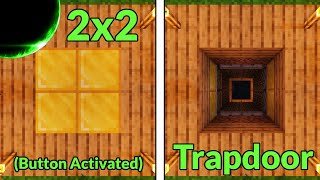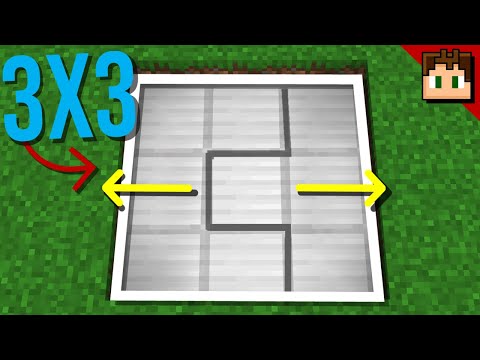
Video: Minecraft Bedrock: Easy 3x3 FLUSH Trapdoor! 1.21 Tutorial by Tomco
How to build it
- Prepare the 9x5x3 Excavation Area
Clear out a 9x5 block area below where you want your 3x3 floor opening to be. Leave a 3-block vertical gap between the surface floor level and the bottom of the pit where your wiring will sit.
- Place the Slime and Honey Grid
Directly underneath the 3x3 trapdoor space (one block below floor level), build a 3x3 platform using 4 slime blocks on one side and 5 honey blocks on the other. You can swap which side holds the 4 or 5 blocks, as long as one half is slime and the other is honey so they do not stick to each other.
- Install the Bottom Sticky Pistons
Go to the front side of the 3x3 grid and look underneath it. Place two upward-facing sticky pistons at the bottom of the pit—one positioned to pull down the slime block section and one positioned to pull down the honey block section.
- Create the Input Block
Place two solid blocks directly behind the two bottom sticky pistons, and run redstone dust across both of them. Attach one extra solid block to that dust line to act as your main input block, and attach a lever to it for testing.
- Start the Side Delay Lines
Place a solid block on both the left and right sides of your two initial redstone dust pieces. On top of these blocks, place a redstone repeater facing outward on each side and set both repeaters to a 3-tick delay.
- Step the Signal Upward
In front of each 3-tick repeater, place a solid block, and then place another solid block stepping up and outward by one. Put redstone dust on top of these new blocks on both the left and right sides.
- Add the Second Set of 3-Tick Repeaters
Continuing along the outer edges toward the sides of the slime and honey platform, place another solid block with redstone dust, followed by a repeater set to a 3-tick delay running into a solid block. Mirror this exact setup on both sides.
- Wire the 1-Tick Inner Repeaters
From the blocks you just placed, step inward toward the center on both sides with a solid block. Place a redstone repeater set to a 1-tick delay on each of these blocks, facing toward the slime and honey platform.
- Place the Side Double Piston Extenders
On top of the solid block sitting in front of the second 3-tick repeater, place a sticky piston facing inward toward the trapdoor center, and place a second sticky piston directly in front of the 1-tick repeater right beside it. Repeat this on the opposite side so both the slime and honey sections have a pair of horizontal sticky pistons ready to pull them apart.
- Fill the Floor and Line the Shaft
Place your 9 floor blocks directly on top of the slime and honey blocks and flick the lever to close the door. Frame the surrounding floor and the top walls of the drop shaft—including the spaces directly underneath the retracted slime and honey blocks—using glazed terracotta (or obsidian) so the sticky blocks do not grab the walls, making sure not to block the front of the bottom sticky pistons.
How it works
This trapdoor relies on separating the 3x3 floor into two distinct movable sections: a 4-block slime block group and a 5-block honey block group. Because slime and honey do not stick to one another, the two halves can be moved independently without exceeding the 12-block piston push limit or jamming against the surrounding walls.
- Closing Sequence (Extending): When the input block is powered, the signal splits left and right through two sets of 3-tick repeaters (6 ticks total) before reaching the outer pistons. Meanwhile, the bottom upward-facing sticky pistons receive power instantly, which works alongside the horizontal double-piston action on each side to push the slime and honey sections inward to the center and then upward so the floor sits flush.
- Opening Sequence (Retracting): When the lever is turned off, the bottom sticky pistons unpower first, pulling the slime and honey groups down by one block out of the floor frame. After the repeater delays expire, the horizontal sticky pistons on the left and right trigger in sequence (3 ticks and 1 tick) to pull the lowered slime and honey modules outward into the side walls, clearing the 3x3 drop shaft.
- Non-Sticky Lining: Glazed terracotta cannot be pulled by slime or honey blocks, allowing the mechanism to slide cleanly past the inner shaft walls without tearing the corridor apart.
Tips & variations
- Block Choices for the Shaft: Any block that directly touches the moving slime or honey blocks during retraction must be immobile or non-sticky. Glazed terracotta, obsidian, crying obsidian, or even shulker boxes will work. Once you are deeper down the shaft below the moving mechanics, you can switch back to any normal building block.
- Keep the Bottom Pistons Clear: When placing glazed terracotta underneath the retracted slime and honey blocks to hide the redstone, make sure you leave the space directly above the two bottom upward-facing sticky pistons empty so they can extend up to grab the platform.
- Connecting Custom Inputs: To wire this door to a hidden lever, button with a T flip-flop, or pressure plate system away from the build, simply run a redstone line with a repeater pointing directly into the back input block.
- Bedrock Edition Exclusive: This specific wiring and repeater timing is calibrated for Minecraft Bedrock Edition piston speeds and lacks quasi-connectivity, so it will not function properly on Java Edition without modifications.