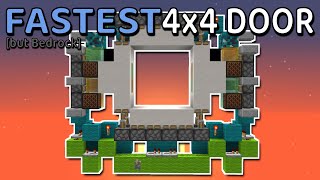
Video: Minecraft Bedrock - 4x4 FLUSH PISTON DOOR 🚪 [ Tutorial ] PS4 / MCPE / Xbox / Windows / Switch by Skippy 6 Gaming
How to build it
- Dig the Base Trench and Place Bottom Pistons
Dig a trench that is 12 blocks wide, 3 blocks long, and 3 blocks deep. On the fourth block in from both the left and right sides, place an obsidian block on the floor, put a line of four upward-facing sticky pistons across the center between them, and place one extra upward sticky piston directly on top of the two outer pistons.
- Build the Side Piston Columns
Skip one space outward from your bottom piston row and place a column of four sticky pistons facing inward toward the door frame, backed by a second column of two sticky pistons behind the middle two. Repeat this exact side-piston setup on the opposite side of the trench so both sides mirror each other.
- Add the Top Pistons and Door Blocks
Above the door frame, place your remaining two obsidian blocks on the outer corners mirroring the bottom ones, with a horizontal sticky piston facing inward off each obsidian block. Between them, suspend four downward-facing sticky pistons (with two extra downward pistons stacked above the outer two), then fill in the 4x4 doorway frame and floor with your solid building blocks.
- Wire the Under-Floor Repeaters
Before sealing the floor, lay a row of six solid blocks underneath the bottom pistons with two additional blocks jutting out on the front and back corners. Place four redstone repeaters set to 4 ticks on the corner blocks and cover the middle six blocks with redstone dust.
- Construct the Side Torch Towers
On both sides of the bottom redstone line, step a block up with redstone dust and build a 4-block vertical redstone torch tower alternating blocks and torches upward. Place two extra redstone torches on the inward-facing sides of the tower blocks, then attach a downward-facing sticky piston with a solid block on its face directly beneath the top side torch.
- Wire the Top Piston Array
Move to the top of the door and place solid blocks along the upper pistons to hold two mirrored L-shapes of redstone dust. On the back of both upper corners, lead two upper slabs and solid blocks out from the top torch into a 3-tick repeater feeding a downward-facing sticky piston holding a solid block, and connect the path back with redstone dust.
- Add the Lower Timing Circuits
At the bottom rear on both sides, build a small loop of solid blocks emerging from the base wiring. Place a 2-tick repeater running into a block, followed by a 1-tick repeater into a block with redstone dust, and finish with a 1-tick repeater feeding back into the lower side piston block.
- Install the Rear Slab and Torch Risers
Behind the side piston columns on both sides, build a small vertical chain of torch, block, torch, and block topped with redstone dust. Attach an upper slab next to it holding a 1-tick repeater running into a solid block to power the middle pistons.
- Connect the Outer 2-Tick Repeater Loops
Wrap around the outside of both side walls using a pattern of solid blocks and a half slab to carry redstone dust around the piston housing. Set a repeater on this outer bridge to 2 ticks, then place a block above the lower line to cut the wire, attach a redstone torch, and run a 2-tick repeater on a slab into the side block.
- Finish the Lower Torch Towers and Input Lever
At the bottom outer corners on both sides, add one final short tower of torch, block, torch, block feeding a 1-tick repeater into the lower piston frame. Crucially, tuck one final piece of redstone dust under the inner slab on the third block up on both sides so the top circuit connects, then attach a lever to the bottom input line to test your door.
How it works
This 4x4 flush door operates by splitting a single lever input at the base into two completely symmetrical left and right halves:
- Bottom & Top Double Extenders: The central 4x4 opening requires the inner four blocks to be pulled up and down by two blocks, while the outer frame blocks only need to move one block inward and one block flush into the wall. The 4-tick repeaters under the floor and the 3-tick repeaters at the roof coordinate the push and retraction pulses for the vertical pistons.
- Vertical Torch Towers: The twin redstone torch towers invert and carry the floor signal straight to the roof while simultaneously firing downward-facing sticky pistons. When these helper pistons extend a solid block, they complete the circuit for the secondary retraction pulse.
- Side Extenders & Obsidian Anchors: The side walls use staggered 2-tick and 1-tick repeaters along with upper slabs (which carry signal upward in Bedrock without cutting adjacent dust) to fire the back and front sticky pistons in sequence. The four obsidian blocks act as immovable stops so the horizontal helper pistons at the corners don't push the frame out of alignment.
Tips & variations
- Don't Miss the Hidden Dust: If the top half of your door fails to close properly during testing, double-check that you placed the single piece of redstone dust underneath the upper slab on the third block high on both the left and right sides.
- Reset Pistons While Building: Placing redstone torches during construction will temporarily fire nearby sticky pistons. Make sure all pistons and movable blocks are returned to their home positions before flipping the main lever.
- Adding a Second Lever: To open and close the door from both sides of the hallway, extend a redstone dust line with repeaters from the bottom input line around the outside of the door frame to the opposite wall.
- Bedrock Edition Specifics: This circuit is timed specifically for Minecraft Bedrock Edition (MCPE, Xbox, PS4, Nintendo Switch, Windows) where pistons lack quasi-connectivity and redstone dust travels reliably up half slabs.