Video: 7-Segment Display with Signal Strength Input - Tutorial | Minecraft (All Versions!) by Maizuma Games
How to build it
- Build the 7-Segment Lamp Face
Construct a 4-wide by 7-tall display face using Redstone Lamps for the seven numeric segments and dark solid blocks (such as black terracotta) for the background. The entire build will require a 4x9x13 footprint behind and including this face.
- Set Up the Reference Signal
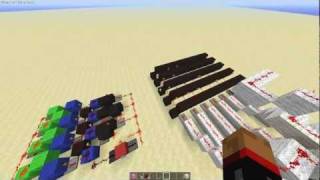
At the base of the decoder, place a furnace containing 12 snowballs and 1 non-stackable item to output a constant signal strength of 9. Read it with a comparator set to subtraction mode, run the line along the base, and place a row of 10 repeaters facing into the decoder set to 4 ticks.
- Build the Signal Strength Decoder Base
In front of the repeaters, place a row of 10 solid blocks with 10 redstone torches on top. Behind the comparator line, arrange alternating solid blocks, comparators, and redstone dust to compare the reference line against your input.
- Add the Input Subtraction Circuit
At the input end, place a full furnace or hopper feeding into a comparator in subtraction mode pointing into a solid block. Feeding a signal strength into the side of this comparator (or powering the block directly) selects digits 0 to 9, while a strength of 10 to 15 turns the display completely off.
- Extend the Vertical Torch Tower
Above your first row of 10 decoder torches, stack alternating rows of 10 solid blocks and 10 redstone torches until you have three vertical rows of torches and three rows of blocks above them. This vertical bus carries the decoded single-digit signal upward to all segment lines.
- Wire the Lower-Right Segment
Place a line of blocks next to the bottom of the torch tower leading toward the display face, using a 4-tick repeater followed by a 1-tick repeater for timing synchronization. Leave the torch for digit 2 unlinked so that segment turns off only when displaying the number 2.
- Build the Blue Segment Line
On the opposite side, run a line of blocks up to the display with a 4-tick repeater and redstone dust on top. At the back, build a small torch tower feeding a comparator in subtraction mode, then place repeaters along the torch bus in a pattern of: 1 repeater, skip 1, 2 repeaters, skip 1, 2 repeaters, skip 1, 2 repeaters.
- Add the Middle Torch-Encoded Line
Run another line of solid blocks along the torch tower with redstone dust on top feeding a 4-tick repeater at the front. Place redstone torches along the side starting from the back by skipping the first block, placing 1 torch, skipping 1 block, and placing 2 torches.
- Construct the Upper-Left & Center Lines
Extend the next upper line with a 3-tick repeater and redstone dust, flanked by a platform holding a comparator in subtraction mode, skipping 3 blocks, and placing 2 more comparators plus a repeater. Below it, connect the lower torch output via a 1-tick repeater into the comparator so all segments synchronize.
- Wire the Opposite Upper Segment Lines
On the other upper side, extend a block line with 3 dust from the back, a comparator, a solid block, and dust running forward into a 3-tick repeater. Add the neighboring upper line with a 3-tick repeater, a solid block, a comparator 2 blocks back, and redstone dust across the top, covering exposed dust with solid blocks to prevent cross-talk.
- Complete the Top Orange Circuit
At the very top of the torch tower, count from the first torch (0) up to the fifth torch (digit 4) and place a torch on its side. Build a checkerboard pattern of alternating blocks along the top with pairs of repeaters and redstone dust to encode the remaining upper segments, then test inputs 0 through 9.
How it works
This circuit combines an analog-to-digital decoder ( often called a redcoder) with a vertical diode matrix that powers the seven segments of the lamp display:
- Signal Strength Decoding: The input comparator subtracts your incoming signal (0–9) from a reference strength of 9 generated by the furnace with 12 snowballs and 1 non-stackable item. The comparator chain isolates a single active torch out of the 10-torch row corresponding to the exact signal strength.
- Blanking the Display: If a signal strength of 10 or higher (such as 15 from a lever) is applied to the input, the subtraction outputs 0 across the entire comparator chain, turning off all 10 torches and blanking the display.
- Vertical Torch Bus & Encoding: Each of the 10 bottom torches powers a vertical column of 3 torches. At different heights along this 10-column wall, repeaters, comparators, and side-mounted torches tap into only the specific digits that need a given segment turned on (or off via comparator subtraction).
- Synchronization: Because different segment lines travel through varying numbers of torches or comparators, repeaters along the side lines are set to 3 or 4 ticks so that all seven segments switch simultaneously without flickering.
Tips & variations
- Easy Binary Conversion: Connect a 4-bit binary line into the side of a subtracting comparator using stepped signal strengths (1, 2, 4, 8) to instantly display binary calculator or counter outputs in decimal.
- Flush Input Option: If you are tiling multiple displays or wiring from below, replace the bottom input block with a top slab and power the input block directly rather than using the test furnace.
- Reversing Input Direction: By default, signal strength 0 displays a
9if you power the block directly without the input subtractor, or counts 0–9 with the subtractor. You can mirror the bottom redcoder line from left to right if you want your input line at the back instead of the front, though it adds 2 blocks to the length. - High-Contrast Background: Use dark terracotta rather than wool or concrete around the Redstone Lamps for a clean, easy-to-read numeric contrast.