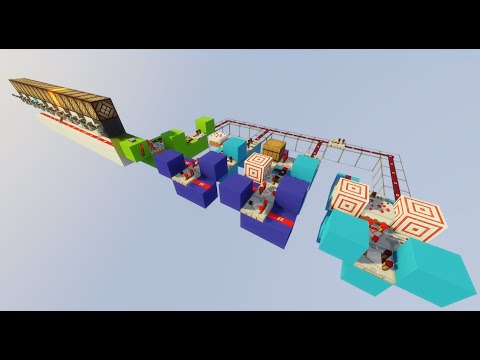
Video: Long Distance Signal Strength Transmission made Simple | Minecraft 1.16+ by Maizuma Games
How to build it
- Set Up the Analog Input and Lock
Place your signal strength source (such as a lectern, item frame, or analog selector) feeding into a comparator. Place a repeater pointing into the side of this comparator to keep it locked until you are ready to transmit.
- Build the Transmitter Pulse Fader
Run the output of the locked comparator into a comparator decay loop (two comparators running alongside redstone dust). When unlocked, this fader slowly ticks down from the input signal strength to zero.
- Add the 2-Tick Send Trigger
Connect a button or 2-tick pulse generator to briefly turn off the locking repeater. A short 2-tick trigger ensures the input value is loaded into the fader only once, even when sending a signal strength of 1.
- Run the Long-Distance Transmission Line
Place a repeater reading the transmitter's fader loop and run a standard line of redstone dust and 1-tick repeaters to your destination. Because the repeater outputs full strength for the duration of the fader, distance no longer degrades your analog value.
- Build the Receiver Counter Core
At the end of the line, build the 4-block decoding core using two comparators set to subtraction mode facing each other's loops. While the incoming line stays powered, this loop incrementally steps up its internal signal strength by 1 for every decay cycle.
- Option A: Standard Memory Receiver
To store the received value continuously, connect the receiver core to a comparator memory loop using a cake (which outputs a constant signal strength of 14) or a container filled to level 14 for subtraction, plus an automatic reset line that clears the old memory as soon as a new pulse arrives.
- Option B: Suppressed Output Memory Receiver
If you do not want downstream circuits reacting while the value is still counting up, replace the cake with a solid container (such as a dropper or furnace) filled to output signal strength 14 and use a target block to redirect the dust so the output stays suppressed at 0 until the pulse finishes.
- Option C: 2-Tick Pulse Output Receiver
If you only need a brief analog pulse rather than persistent memory, omit the storage loop and place two repeaters on the receiver core (one set to 2 ticks and one set to 1 tick) along with target blocks and a cake to emit a clean 2-tick pulse at the exact decoded signal strength.
How it works
This system uses pulse length modulation (converting signal strength to pulse duration, then back to signal strength):
- Encoding (Signal Strength to Pulse Length): When you trigger the sender, the locking repeater briefly turns off and lets the input signal strength enter the comparator fader loop. Because a comparator fader loses 1 signal strength per cycle, a higher signal strength takes proportionally longer to decay completely. A repeater reading this fader outputs a continuous digital ON pulse for the entire decay time.
- Transmission: The pulse travels across any distance using regular redstone dust and standard repeaters. Each unit of signal strength corresponds to roughly 2 redstone ticks of pulse length (a 2:1 ratio; for example, a 10-tick stone button press directly on the line equals signal strength 5).
- Decoding (Pulse Length to Signal Strength): At the receiver, a reference source of signal strength 14 (provided by a slice-taken cake or a calibrated container) feeds into a pair of subtracting comparators. For every cycle the incoming transmission line remains ON, the subtraction feedback loop increments the output signal strength by 1, stopping on the exact number that was originally sent.
Tips & variations
- Use a 2-Tick Input Trigger: Pressing a standard 10-tick button directly on the transmitter when sending a very low value (like signal strength 1) stays active longer than the fader itself, causing the signal to be sent twice. Always limit the trigger to a 2-tick pulse.
- Prevent Counting Glitches: The basic memory receiver visibly counts up from 1 to your target number. If your contraption triggers prematurely while the numbers are ramping up, build the second receiver variant with the level-14 solid container to mute the output until counting completes.
- Compact Pulse Receiver Caveat: You can shorten the pulse-output receiver by removing two rows of blocks and adding a 1-tick repeater to supply signal strength 14 instead of a cake. However, when sending a maximum signal strength of 15, the shortened version causes an observer watching the output to pulse twice instead of once. Stick to the full cake-and-target version if you need a strict 2-tick output pulse across all 15 values.
- Zero Value Limitation: Because a signal strength of 0 generates no pulse at all, this setup transmits 15 distinct values (1 through 15).