
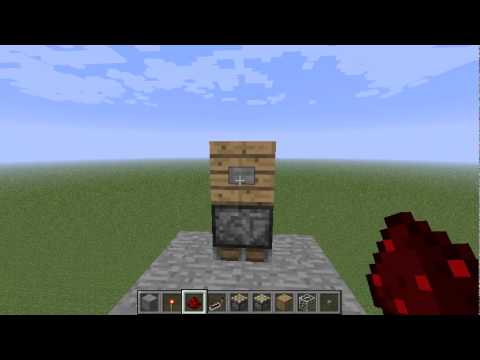
Video: Redstone Quickie #2 - Downward Signal by WhileTrueCode
How to build it
- Place the Top Input and Piston
At your upper platform, place a button on a block where you want your input. Directly underneath the powered block, place a regular (non-sticky) piston facing downward.
- Build the Vertical Block Column
Extend a vertical 1x1 line of solid blocks downward from the face of the top piston. Near the bottom of this column, include a transparent block like glass so it can control the detector circuit below.
- Place the Bottom Reset Piston
Leave a one-block gap below the bottom block of your vertical column, then place a second regular piston facing upward. This piston will push the entire column back up after each press.
- Create the Bottom Detector Output
Set up a power source and a redstone repeater or wire running adjacent to the bottom of the column where the solid block pushes down in place of the glass. When the column shifts down, a solid block moves into position to let the signal pass through as your main output.
- Wire the Automatic Reset Delay
Branch a redstone line off your bottom output and run it through three redstone repeaters set to maximum delay (4 ticks each). Loop this delayed line into the bottom upward-facing piston so it fires once the top button has unpowered.
- Add a T Flip-Flop for a Toggle Output (Optional)
If you need a constant on/off toggle instead of a pulse, connect the bottom output pulse into a compact T flip-flop. Now every button press at the top will toggle your basement circuit on or off.
How it works
This circuit uses piston push limits rather than redstone dust to carry a signal straight down a 1x1 shaft:
- Downward Push: Pressing the top button powers the downward-facing regular piston, pushing the entire vertical stack of blocks down by one block.
- Signal Detection: In its resting state, a piece of
glasssits in the detection slot at the bottom, preventing power from passing through. When the column shifts down by one block, a solid opaque block takes its place and completes the circuit at the bottom. - Delayed Reset: The bottom output splits into a delay line made of three
redstone repeaterson full delay. Once the top button turns off and the top piston retracts, the delayed signal reaches the bottom upward-facing piston, shoving the column back up to its resting position.
Tips & variations
- Piston Push Limit: A standard piston can only push up to 12 blocks at once. Make sure your vertical column does not exceed 12 blocks in length.
- Use Buttons, Not Levers: Because the bottom piston needs the top piston to retract before it can push the column back up, a button pulse works much better than a lever. Pair the bottom output with a T flip-flop if you need a persistent toggle state.
- Disguising the Shaft: Because the vertical line is just solid blocks, you can match the blocks to surrounding walls or pillars inside rooms so the wiring stays completely hidden.
- Tuning the Reset Delay: Three repeaters on max delay safely waits out a standard button press, though you can experiment with slightly shorter delays depending on your button type.


