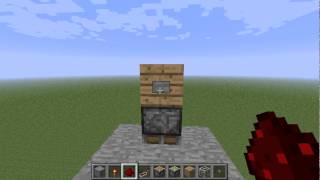
Video: Minecraft Crowd Sourcing: Solution! 1x1 Vertical Downward Transmission by MartinoDF by Cubehamster
How to build it
- Place the Top Input Piston
At the top of your 1x1 vertical shaft, place a sticky piston facing straight down. Attach a lever or your chosen redstone input to the top or side of this piston.
- Attach the Redstone Lamp and Detector Rail
Leave a one-block gap below the downward-facing sticky piston and place a redstone lamp so the piston will push it when extended (or place it directly against the piston head). Place a detector rail right on top of the redstone lamp.
- Add the Minecart
Place a regular minecart onto the detector rail sitting on the redstone lamp. The minecart will stay attached to the rail as the lamp moves up and down.
- Stack Repeat Segments Downward
Directly beneath the redstone lamp, place the next downward-facing sticky piston. Repeat the pattern of sticky piston, detector rail on a redstone lamp, and minecart as far down as you need the signal to travel.
- Build the Bottom Output
At the very bottom of the column, use a redstone torch on the output block so that when the final sticky piston retracts or extends, it inverts the signal and powers your output device or indicator light.
How it works
This vertical downward transmitter works by physically moving an always-active power source inside a strict 1x1 footprint:
- Minecart Power Source: A minecart resting on a
detector railcontinuously powers that rail and strongly powers the block directly beneath it—in this case, aredstone lamp. - Signal Propagation: When the top
sticky pistonreceives power, it pushes the lamp, detector rail, and minecart assembly downward by one block. - Chain Reaction: Pushing the powered redstone lamp down brings it into contact with the next downward-facing sticky piston below it (or updates and powers it via redstone/quasi-connectivity mechanics), causing that piston to extend as well.
- Retraction & Output: When the top input turns off, each sticky piston retracts its redstone lamp and minecart upward in sequence, cutting power to the piston below it and toggling the
redstone torchinverter at the bottom of the line.
Tips & variations
- Not Directly Tileable: Because the powered detector rails and redstone lamps will power adjacent blocks on the same horizontal plane, you cannot place two of these 1x1 pillars directly side-by-side.
- Checkerboard Layout: To pack multiple downward lines close together without cross-talk, arrange the 1x1 columns in a staggered checkerboard pattern when viewed from above.
- Historical Note: This design was created before Redstone Blocks and Observers were added to Minecraft; in modern versions you can also explore observer chains or wall/scaffolding updates, though this piston-and-minecart method remains a clever mechanical solution.