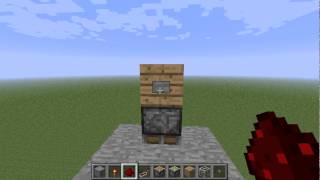
Video: Minecraft Redstone - Downwards Redstone Signal Instawire by Wetbikeboy2500
How to build it
- Set up the top input
Place your input power source at the top of the shaft where you want the vertical signal to start. For instant-reset designs, connect the input through a quick monostable pulse circuit so the downward line receives a clean trigger.
- Build the vertical piston column
Place a downward-facing piston underneath the top input block. You can build a compact 1x1 vertical column for a simple fast line, or use the repeating module layout of one glowstone block and two stone blocks stepping downward.
- Wire the signal transfer blocks
Place redstone dust on the glowstone and stone steps so that when the top piston extends downward, it completes the connection and powers the next downward piston below it.
- Add the instant re-extension side line
To make the pistons reset immediately after firing, run an adjacent vertical line of glowstone (making a compact 2x1 or 2x2 shaft) wired with redstone dust to carry power diagonally and repower the pistons so they extend again.
- Connect the bottom output
At the bottom of the vertical column, place your receiving piston or output redstone line so it triggers as soon as the final downward piston extends.
How it works
This downward instant wire works by chaining vertical piston movements together instead of waiting for redstone torches to invert states:
- Downward Extension: When the top input triggers, the first downward piston pushes its block down, immediately transferring power into the next module below it.
- Glowstone Transmission: Using
Glowstonealong with solidStoneblocks allows redstone dust to travel diagonally without cutting off the wire, linking each vertical stage to the next. - Instant Re-extension: While standard vertical piston lines wait to retract, the upgraded designs include a secondary side line and a monostable input circuit (adding about 4 ticks on the reset side) that repowers the line so the pistons automatically re-extend for the next pulse.
Tips & variations
- 1x1 vs 2x1 Footprint: The basic online design fits inside a 1x1 vertical column, while adding the self-resetting glowstone line expands the shaft to roughly 2x1 or 2x2.
- Diagonal Powering: Remember that glowstone (or another transparent block that supports redstone dust) only transmits power diagonally upward, so place a solid block where needed to actually power the piston beside it.
- Use a Monostable Input: If you use the instant re-extending version, feed your input through a monostable circuit so the line receives a controlled pulse rather than locking on.