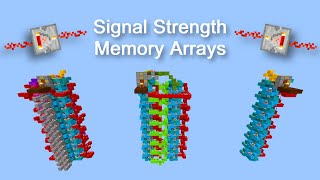
Video: Advanced Redstone Computer Tutorial 12: Starting the Registers by bennyscube
How to build it
- Build the Repeater-Lock Write Cell
Start by placing your data input line leading into a redstone repeater. Point a second repeater directly into the side of the first repeater to act as the repeater lock (D flip-flop), and place an inverting redstone torch on the write-enable input so the repeater stays locked by default.
- Add the Inverted Read Gate
At the output of the locked data repeater, build a simple NOR-based read gate using a solid block and a redstone torch. Incorporate an inverting redstone torch on the read-enable line so the cell only outputs its saved state when the read line is triggered.
- Include Vertical Signal Towers
Add glowstone blocks with redstone dust to carry the vertical control and data lines up or down the cell. Keep the single-bit memory cell within a 3-block-wide footprint so it can be cleanly tiled.
- Stack Horizontally for 8 Registers
Clone or build the 3-wide memory cell 7 more times horizontally in a row. This creates a row of 8 separate register columns (24 blocks long in total).
- Stack Vertically for 8-Bit Bytes
Stack the entire row of 8 cells downward 7 times so that each vertical tower is 8 bits tall. Each vertical column now stores 1 full byte (8 bits) of data, giving the bank a capacity of 8 bytes.
- Replace Bottom Glowstone with Solid Blocks
Go along the very bottom of every vertical glowstone tower in the register bank and replace the lowest glowstone block with a solid opaque block (such as snow, iron, or wool) so the bottom signal can properly power adjacent components.
- Build the Second Dual-Read Bank
Construct or clone a second, mirrored 8-byte register bank on the opposite side of your ALU input lines, leaving a 1-block gap from the bus connection point. Remember to replace the bottom glowstone blocks with solid blocks on this second bank as well.
How it works
This register architecture uses a dual-read system, which saves every written value twice—once in a left register bank and once in a right register bank flanking the ALU. This allows the CPU to read two separate registers simultaneously into the ALU's A and B inputs without extra multiplexing.
- Repeater-Lock D Flip-Flop (Write): Each 1-bit cell stores data inside a redstone repeater locked from the side by another repeater. The write line is inverted with a redstone torch so the lock repeater stays powered by default, freezing the data repeater's state. When a write pulse arrives, the torch turns off briefly, unlocking the repeater so it takes in the new
1or0from the vertical input line before locking again. - NOR Gate (Read): The output of the locked repeater feeds into a torch-based gate controlled by an inverted read line. As long as the read line is off, the cell outputs nothing to the bus. When the read line is activated, the gate unlocks and allows the stored bit to pass out to the ALU.
- Vertical Byte Towers: Each 3-wide vertical column contains 8 stacked cells (1 byte), and 8 columns sit side by side to provide 8 addressable 1-byte registers per side.
Tips & variations
- Java Edition Only: Because this design relies on tight repeater-locking timings and glowstone vertical wiring behavior, the creator notes it will not work reliably on console/Bedrock editions.
- Fix the Bottom Glowstone: When stacking cells vertically (especially with WorldEdit), the bottom block of the vertical tower will default to glowstone. Since glowstone is transparent and cannot be powered to transfer signals the same way opaque blocks do, you must replace the bottom block of every column with a solid block.
- Bus Clearance: Leave a 1-block horizontal offset between the register outputs and the ALU alignment so you have space to run the connecting bus lines without unintended glowstone connectivity.