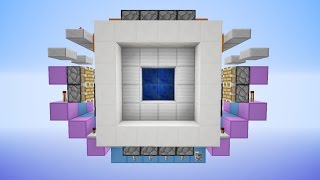
Video: The BEST Piston Door In Minecraft! by CraftyMasterman
How to build it
- Build the 3x3x4 Door Frame
Clear a 9x4x9 area and build a 3x3 doorframe two blocks above the ground, leaving two blocks of empty space on all sides. Extend the frame so it is 4 blocks deep; the door consists of a central 3x3 layer flanked by two outer donut-shaped rings.
- Place the 3-Layer Piston Layout
On the back layer of the frame, arrange sticky pistons in an inward-facing spiral pattern to form the back ring. Build the central layer using single pistons and double piston extenders to push the middle blocks, then repeat the spiral sticky piston pattern on the front layer.
- Run the Front Input Line and Tower
Place a row of wiring blocks across the bottom front of the door, swapping the second block for a note block and the fourth for a transparent block (glass or top slab). Run three transparent blocks up the right side with redstone dust climbing to the top, and place your input lever on one of the four bottom blocks.
- Wire the Front Ring Top and Left Side
At the top of the front layer, run redstone dust over the top piston into a pair of 1-tick repeaters, a downward observer with a 2-tick repeater, and a left-facing observer. Down the left side, connect a 2-tick repeater into two observers powering the top-left piston, and route an observer line from the bottom note block to a sticky piston holding a redstone block.
- Build the Top-Right Retraction Circuit
On the right side of the front layer, place a 3-tick and 1-tick repeater feeding upward observers. In the top-right corner, place an upward observer into a front-facing sticky piston with a solid block in front of it and a left-facing observer beside it to create a double-pulse retraction module.
- Start the Center Layer and Right Redirects
Move to the bottom middle of the door and place a downward observer topped with redstone dust. On the right side behind the 3-tick repeater, add a 2-tick repeater pointing into the middle piston, a block with dust, a target block to redirect the line, and a note block higher up.
- Add the Composter and Glass Pane Double-Pulser
Near the upper right of the center layer, place a composter filled to level 1 with a comparator reading it into redstone dust and a target block. Above it, set up a downward sticky piston moving the composter, an observer chain driving a downward regular piston, and a glass pane next to the piston with an observer reading the shape updates into the double piston extender.
- Finish the Center Layer with the Activator Rail
In the remaining corner of the middle layer, place a downward observer in front of the repeater with an activator rail on top. Next to it, place a downward regular piston spaced one block away from an observer, powered by a 1-tick repeater and dust on transparent blocks, then test that the first two layers open and close cleanly.
- Wire the Back Layer Trapdoor and Glass Pane
On the third layer, run dust over a transparent block into a note block with two observers feeding the upper piston and a 1-tick repeater on top. Place a glass pane on the note block with a trapdoor beside it so the trapdoor connects to the pane when toggled, and run two upward observers from the glass pane into the back piston.
- Complete the Back Layer Sides and Bottom
On the left of the back layer, add a 1-tick repeater into the side piston, an observer topped with the second activator rail, and a note block beside the target block. On the right and bottom, add a 3-tick repeater feeding upward observers from the comparator line, and place a bottom piston with redstone dust and upward observers under the lowest pistons before resetting all door blocks.
How it works
Every module in this 3x3 vault door follows a synchronized 4-step sequence for both closing and opening:
- Closing Sequence: First, a single piston extends to push a door block in front of the double piston extender. Second, the front piston of the double extender receives an inert pulse. Third, the back piston of the double extender powers, pushing the block column into the frame. Fourth, a final retraction pulse fires harmlessly while the door is closed.
- Opening Sequence: Using the exact same timing line, the single piston retracts its block first. The front piston of the double extender pulses briefly to grab the center block, the back piston pulls the front piston back, and the fourth pulse fires the front piston one last time to complete the double retraction.
- Block-State Double Pulsers: To fit everything in a 4-block-wide footprint, the circuit uses clever observer tricks. In the top-right corner, an observer watches a sticky piston spit out and pull back a block: extending gives one update, while retracting detects both the piston head and the pulled block for two quick pulses. In the middle and back layers, pistons or a trapdoor change the connection shape of a
glass paneto send rapid double updates into adjacent observers.
Tips & variations
- Accidental Piston Triggers While Building: Placing redstone dust next to already-powered lines can prematurely fire the double piston extenders or pull the composter out of place. As shown in the video, you can rapidly left- and right-click with redstone dust to update the line, or temporarily place and flick a lever on the sticky piston to push the composter back.
- Composter Fill Level: Make sure the composter is filled at least once so the comparator outputs a constant signal when the composter is pushed into position.
- Trapdoor Orientation: When placing the trapdoor next to the glass pane on the third layer, verify that closing the trapdoor actually makes the glass pane connect to it, otherwise the observer underneath will not detect the shape change.
- Java Edition Only: This build relies heavily on sticky pistons spitting out their blocks on a 1-tick pulse and specific note block/activator rail update behaviors, which only work in Minecraft Java Edition.