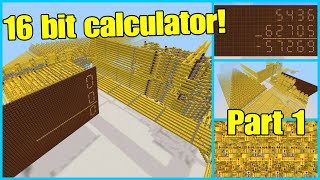
Video: Redstone Multiplier Tutorial (Part 1 of 2) by bennyscube
How to build it
- Set Up the Bit Inputs and Comparator XOR
Place two input levers for your first bit slice and connect them with a line of redstone dust. Place two comparators set to subtract mode facing away from the inputs, routing the dust so each input feeds BOTH the rear and the side of the opposing comparator to form a compact XOR gate.
- Invert the XOR Output for Carry Generation
Run the combined output of your comparator XOR gate into a solid block with a redstone torch attached to it. This inverted signal acts as your preliminary carry line, which turns on whenever both inputs are identical (either both 1 or both 0).
- Build the Carry-Cancel Logic
To prevent a carry from triggering when both inputs are 0, place a redstone torch on the input line so it only stays lit when both levers are off. Run a repeater from this torch into the side of a subtract-mode comparator placed on your carry line to cancel out false carries.
- Construct the Slab Towers for Carry and Cancel
Build two vertical half-slab towers next to the carry and cancel outputs. Using top slabs allows the redstone signals to travel upward into higher bit slices without flowing backward into lower bits.
- Wire the Secondary XOR for Carry-In
Take a repeater output from your first XOR gate and combine it with the carry-in line coming from the bit below using redstone torches and blocks. Arrange the torches so the final output turns on if either the first XOR or the carry-in is active, but turns off if both are active simultaneously.
- Stack the Adder Vertically to 8 Bits
Each complete adder slice is designed to be 2 blocks tall. Replicate and stack this exact slice 7 more times directly on top of the first one (either by hand or using WorldEdit copying upward by 2 blocks per step) to create an 8-bit vertical adder.
- Add the Carry-In Input at the Bottom
At the very bottom of the first bit slice, remove the unused hanging slab sections and place solid blocks to feed into the carry tower. Attach a redstone torch and a repeater leading into the bottom carry path so the multiplier will be able to inject a +1 carry-in signal when needed.
How it works
Binary multiplication mirrors long multiplication on paper: you multiply the first number by each digit of the second number, shift the results based on place value, and add all the partial products together. Because binary only uses 0 and 1, generating partial products is simple, and the main work is handled by the adder.
- First Stage XOR (Half Adder): Two subtract-mode comparators compare the signal strengths of Input A and Input B. If only one input is on, there is a signal difference of 1, producing an output of
1. If both are on (1 + 1) or both are off (0 + 0), the strengths cancel out to0. - Carry-Cancel Technique: Instead of cascading slow carry gates through every bit, this adder assumes a carry is present whenever the first XOR outputs
0. Because0 + 0also outputs0, a NOR torch checks if both inputs are off and sends a cancel signal into the side of the carry comparator to block false carries. - Slab Propagation: The carry and cancel lines travel straight up half-slab ladders, allowing carries to ripple across multiple bits almost instantly before being XORed with each bit's local sum.
Tips & variations
- Using WorldEdit: Because each bit is identical and 2 blocks high, you can select one slice and run
//stack 7 uor copy and paste 2 blocks up at a time using the-aflag so air blocks do not overwrite overlapping slab connections. - Survival Building: If you are building in survival without WorldEdit, you can construct just 2 to 4 vertical layers to make a smaller 2-bit or 4-bit multiplier before scaling up to 8 bits.
- Slab Placement: Double-check that all vertical signal towers use upper slabs (or transparent blocks that support dust); placing a full solid block by mistake will cut the vertical wire and break multi-bit carries.