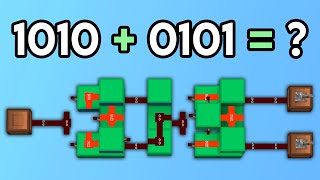
Video: Minecraft Beginner Full Redstone Adder by DoctorPlasma
How to build it
- Set Up the Two Main Inputs
Place two distinct rows of blocks to represent Input A and Input B, with a lever on the front of each and redstone dust on top. Place a redstone torch on the back of both input blocks to invert the signals.
- Build the First OR Gate
Run redstone dust from the two input torches so their signals merge into a middle block. Place a block above this line with a redstone torch to create a double negative, acting as an OR gate.
- Complete the First XOR Gate
Place an additional pair of torches on the side of your two input blocks and connect them with a piece of redstone dust to act as an inverted AND gate. Place one more torch feeding back into the main output line so that the output turns off when both inputs are active.
- Create the Carry-In Input
Extend the output line from your first XOR gate to serve as the first input for the second stage. Build a parallel input line right next to it, which will act as your Carry-In line from a previous adder bit.
- Build the Second XOR Gate
Repeat the exact same compact XOR torch arrangement using the first XOR's output and the Carry-In line as your two inputs. The final torch on top of this second stage is your Sum (ones place) output for this bit.
- Wire the First Carry-Out Line
Tap into the middle AND section of the first XOR gate (which turns off only when both main inputs are on) by placing a block with a redstone repeater running out of it. Run that repeater into a block with redstone dust and invert it with a side torch heading toward the next bit.
- Wire the Second Carry-Out Line
Tap into the middle AND section of the second XOR gate and run a redstone dust line toward the Carry-Out side. Place a solid block above the adjacent wire to cut it off so the line doesn't short-circuit into itself, then invert it with a torch on a block so both carry conditions merge into the next unit's Carry-In.
- Tile the Adder and Connect Lamps
Repeat or clone the entire module side-by-side so that the Carry-Out torches of each slice directly power the Carry-In line of the slice next to it. Connect a redstone lamp to the final Sum output of each unit and label them in powers of two (1, 2, 4, 8, 16, 32, 64, 128) to test your binary addition.
How it works
Binary addition follows the exact same rules as regular decimal math: you add two digits together to get a sum, and if the result is too large for one column, you carry the 1 to the next place value.
- First Stage (Half Adder): The first compact XOR gate compares Input A and Input B. Because an XOR gate only outputs
ONwhen the inputs are different,1 + 0or0 + 1yields1, while0 + 0and1 + 1both yield0in the ones column. - Second Stage (Full Adder Sum): A full adder must also account for a carried
1from the previous column. The output of the first XOR gate is fed directly into a second XOR gate alongside the Carry-In line. If both inputs are1(making the first XOR output0) and a1is carried in, the second XOR outputs1(representing a total of 3, which is11in binary). - Carry-Out Logic: You need to carry a
1to the next bit in two situations: either both main inputs (A and B) are1, OR one of the main inputs is1while the Carry-In is also1. Because the middle section of our torch-based XOR gate naturally calculates an inverted AND condition to turn off the main output, we simply pull a signal from the middle of both XOR gates using a repeater and torch inverters, combining them to form the Carry-Out signal.
Tips & variations
- Color-Coding: Use different colored wool or concrete for Input A, Input B, the intermediate XOR wire, and the Carry lines. It makes debugging much easier when tiling multiple bits.
- Cut-Off Blocks: When running the second Carry-Out dust line tightly next to the second XOR gate, don't forget the solid block placed diagonally to cut the redstone dust connection. Without it, the dust will loop into itself and lock the gate.
- Cloning for 8-Bit Math: If you use the
/clonecommand in Creative mode to duplicate your adder slices, place temporary backing blocks for the shared Carry torches before copying, then remove the excess floating torches on the outer end and turn all levers off before testing. - Cross-Edition Compatibility: Because this classic circuit relies exclusively on basic Boolean logic with redstone torches, dust, and a standard 1-tick repeater, the logic works reliably across all versions of Minecraft.