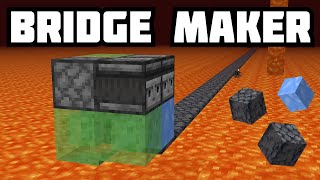
Video: Automatic Basalt Wall Maker by ilmango
How to build it
- Position the Soul Soil and Blue Ice Core
Choose the line where you want your basalt wall to form, starting at the top height of the wall. Place the soul soil and blue ice offset one block behind the wall line so the generated basalt can be pushed forward into position.
- Build the Two-Way Flying Machine Engine
Attach two opposing sticky pistons and slime blocks to the basalt generator core to form a two-way flying machine. Make sure each half stays within the 12-block piston push limit.
- Add the Delayed Basalt Pusher Pistons
Add a three-slime-block extension on each side of the flying machine with a regular piston facing toward the wall line and an upward-facing observer underneath powering the piston through the slime block. Spacing these pistons a few blocks away from the blue ice gives the lava enough time to flow back down before the machine arrives on the return trip.
- Mount the Redstone Blocks
Place a block of redstone on each side of the flying machine, using an extra slime block on one side so the heights match the end stations. These redstone blocks will trigger the downward push mechanisms when the machine docks at either end.
- Build the First Double-Step End Station
Leave a one-block gap past the flying machine and place an upward-facing trigger piston with an observer watching it, leading into a downward regular piston, two slime blocks, an observer, and a downward sticky piston. Because the flying machine drops one block per trip, each end station must step itself down two blocks every second trip.
- Add the Honey Block Arm and Downward Pushers
On the first end station, attach an L-shaped arm of four honey blocks (so they do not stick to adjacent slime blocks) with an observer and sticky piston, plus an upper slime block arm extending four blocks over the machine. Place two downward-facing regular pistons on this upper arm—one powered directly by the machine's redstone block and the rear one delayed by one tick via an observer.
- Build the Second End Station
Move down the line to the far end of your desired wall length and build the second mobile return station one block lower than the first. Use the same double-downward stepper logic with an upward trigger piston, downward pistons, observers, and a five-slime-block upper arm with two downward pusher pistons spaced to match the asymmetrical flying machine.
- Pour the Lava Curtain
Build a row of temporary blocks above the path of the soul soil, keeping at least a one-block gap from the first end station and a three-block gap from the second station so lava never spills onto the redstone. Place lava source blocks along this top row so a curtain of lava flows straight down over the path of the soul soil.
- Launch and Park the Wall Maker
Wait for the lava curtain to flow down, then use a fire charge or flint and steel on the flying machine's rear observer to launch it. When the wall reaches the bottom or you want to pause it, place an immovable obsidian block in front of the machine outside the lava curtain, then remove the top lava sources once finished.
How it works
This contraption combines Minecraft 1.16's basalt generation rule with a 3-axis flying machine system:
- Basalt Generation & Clearing: Whenever flowing lava touches space directly above
Soul Soiland next toBlue Ice, it turns into basalt. Because a newly formed basalt block blocks the lava from flowing further down, a lateral regular piston on the flying machine immediately punches each generated basalt block one block forward into the wall plane. - Return-Trip Timing: On a bidirectional machine, the leading lateral piston could punch through the lava stream and cut it off before the soul soil arrives. Mounting the lateral pistons a couple of blocks away from the core creates a brief delay, allowing the lava to re-flow just in time to generate basalt in both directions.
- 1-Tick Delayed Downward Push: To shift a two-way flying machine downward and reverse its direction, the rear half of the machine must be pushed down 1 game tick before the front half. Each end station has two downward pistons: one is powered directly by the redstone block on the incoming flying machine, and the other is powered through an observer for a 1-tick delay.
- Double-Step End Stations: Because the flying machine moves down one block on the left, flies right, and moves down one block on the right, it arrives at each station two blocks lower than its previous visit. Each station uses a self-stepping piston-and-observer chain that pushes the entire station down twice whenever the flying machine triggers the upward-facing detection piston.
Tips & variations
- Slime vs. Honey Separation: On the first end station, the four-block vertical arm must be built with Honey Blocks rather than slime blocks so it slides past the adjacent slime blocks without sticking and exceeding the 12-block push limit.
- Keep Lava Clear of Stations: Leave a 1-block gap on the starting end and a 3-block gap on the far end between your lava sources and the end stations. If lava flows into the stations as they descend, it can break or obstruct moving components.
- Pausing Safely: If you need to stop the machine mid-wall, place a block of Obsidian in front of the flying machine in the safe gap outside the lava curtain so lava does not spill over the parked machine.
- Java Edition Mechanics: This build relies on Java Edition flying machine and one-tick piston timing behavior introduced with the 1.16 Nether Update basalt mechanics.