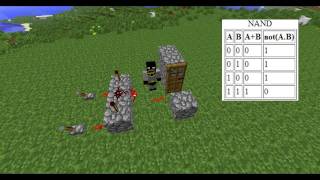
Video: HighTea's Redstone Tutorials [9] - NAND Gates by hightea65lp
How to build it
- Place the Base Blocks
Place three solid building blocks in a straight horizontal row on the ground, just like the base of a standard AND gate.
- Add the Redstone Torches
Place one redstone torch on top of the left outer block and another redstone torch on top of the right outer block.
- Bridge the Torches
Place a single piece of redstone dust on top of the center block so it connects the two redstone torches.
- Wire the Two Inputs
Run two separate redstone dust lines—or attach two levers—directly into the back of the two outer blocks holding the torches.
- Connect the Output Line
Place a trail of redstone dust leading directly out from the center block on the opposite side of your inputs. Do not use a third torch on the front face.
How it works
The NAND gate works by inverting two inputs and merging their signals on a single redstone line:
- Default State (0, 0): When both input levers are off, the two redstone torches on top of the outer blocks remain lit. Both torches power the redstone dust on the center block, which sends an active signal down the output line.
- Single Input On (1, 0 or 0, 1): Flipping just one lever powers that specific outer block, turning off the redstone torch sitting on top of it. However, the other torch is still lit and continues powering the center redstone dust, keeping the output ON.
- Both Inputs On (1, 1): When both input levers are switched on simultaneously, both outer blocks become powered and shut off both redstone torches. With neither torch providing power to the center dust, the output line finally turns OFF.
Tips & variations
- Converting to an AND Gate: The only difference between a NAND gate and an AND gate is the final output. If you replace the first piece of output redstone dust on the front of the center block with a third redstone torch, the signal inverts again and becomes a standard AND gate.
- Common Mistake: Make sure your input dust lines point directly into the outer blocks (or use repeaters) so they hard-power the blocks underneath the torches. If the dust runs past the block instead of pointing into it, the torch will not turn off.
- Silent Operation: Because this gate only uses dust and torches without any pistons or droppers, it switches states completely silently.